
CALENDAR ARCHIVE / 2000
Mining Calendar 2000 – Mining and Minerals in Saxony
The 7th Original Saxon Mining Calendar combines photographs of Saxon mining locations with mineral specimens from the corresponding districts. The year ranges from Zinnwald and Schönbrunn through Niederschlema, Wolkenstein and Pöhla to Glashütte, bringing underground spaces, surface facilities and mineralogical finds together in a single series.
René König has designed the Original Saxon Mining Calendar as a wall calendar since 1994. This archive page presents the complete 2000 edition with its cover and twelve monthly sheets. The descriptions follow the location, find-site, mineral and collection information preserved in the original edition.
7th edition · 13 calendar sheets · Design: René König
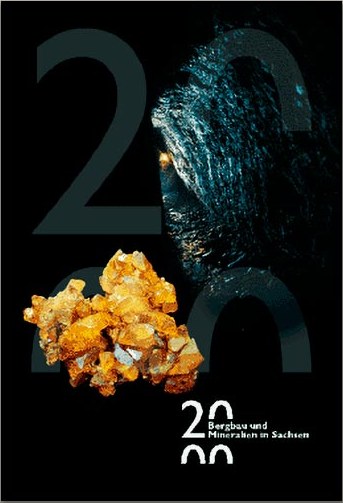
Cover · 2000
Mining and Minerals in Saxony
The cover introduces the annual theme, “Mining and Minerals in Saxony,” on two visual levels. A dark underground photograph forms the background, while a vivid orange mineral specimen appears in front of it. The large numerals of the year 2000 and the high-contrast design bring together the calendar’s two recurring subjects: Saxon mining locations and minerals from the featured districts.
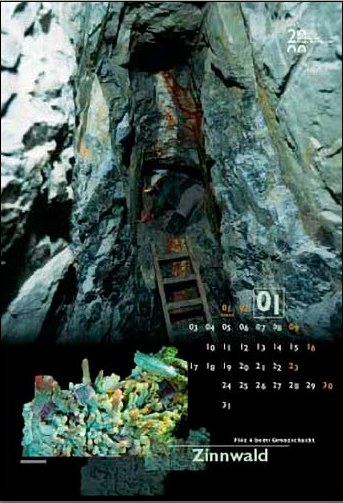
January · 2000
Seam 6 at the Grenzschacht in Zinnwald
The January sheet shows the steep, confined working of Seam 6 at the Grenzschacht in Zinnwald. Wooden ladders provide access through the dark opening and convey the spatial conditions underground. According to the original caption, the accompanying mineral specimen consists of cassiterite and quartz. It comes from a private collection, and the pictured specimen is given a width of 4.5 centimetres.

February · 2000
Fluorite vein near Schönbrunn
February focuses on a fluorite vein near Schönbrunn, close to Oelsnitz in the Vogtland region. A miner with lamp and tool provides a sense of scale within the extensive underground space. The sheet pairs this photograph with a specimen containing fluorite, pyrite, quartz and siderite. The original information assigns it to a private collection and gives the pictured specimen a width of 7.5 centimetres.

March · 2000
Uraninite from Niederschlema
The March sheet takes the viewer to Shaft 371 at Niederschlema. The original caption locates the scene on level −1530, in block 0336. A miner stands before the strongly textured rock face, with a funnel-shaped piece of equipment visible to the left. Below it is a uraninite specimen from the Mineralogical Collection of TU Bergakademie Freiberg, collection number 62095.

April · 2000
Hydrowoodwardite from Bärenhecke
In the St. Christoph adit near Bärenhecke, a miner examines the greenish vein surface directly in front of him. The April sheet contrasts this underground scene with a scanning electron microscope image of hydrowoodwardite. The original caption assigns the mineral to the Mineralogical Collection of TU Bergakademie Freiberg and records collection number 76639.

May · 2000
Silver, arsenic and barite from Wolkenstein
The May motif shows a colourful mineralised vein surface in Shaft 137 at Wolkenstein. The Maria Stehender vein is identified as the precise find area, while a tool placed against the rock conveys the scale of the structure. The featured specimen combines native silver, native arsenic and barite. It comes from a private collection; according to the original note, the tree-like aggregate measures 2.0 centimetres across.
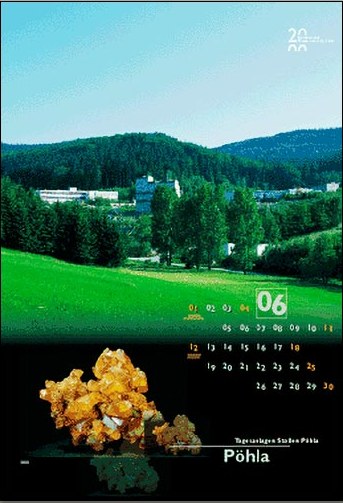
June · 2000
Surface facilities of the Pöhla adit
The June sheet moves from underground motifs to a landscape view of the surface facilities of the Pöhla adit. Buildings and technical structures lie between meadows and wooded hills. An orange barite specimen is reproduced in the lower part of the design. The original caption identifies the Mineralogical Collection of TU Bergakademie Freiberg as its source and gives collection number 709 I 2.
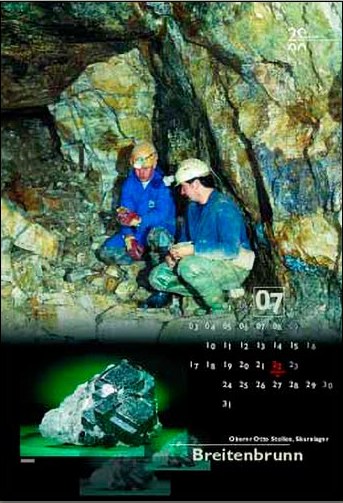
July · 2000
Skarn deposit in the Oberer Otto adit
In July, two miners examine an exposed section of rock in the Oberer Otto adit near Breitenbrunn. The original information describes the geological setting as a skarn deposit. The sheet also presents a dramatically lit andradite specimen. Measuring 7.0 × 5.0 centimetres, it belongs to the Mineralogical Collection of TU Bergakademie Freiberg and bears collection number 61266.

August · 2000
Joseph Morgengang vein near Gersdorf
The August sheet enters the Segen Gottes Erbstollen near Gersdorf, close to Roßwein. A miner stands at the illuminated Joseph Morgengang vein, providing a scale for the high rock wall. The accompanying specimen consists of tetrahedrite, chalcopyrite and fluorite. It comes from the Mineralogical Collection of TU Bergakademie Freiberg, bears number 6365 and is shown at a stated width of 6.0 centimetres.
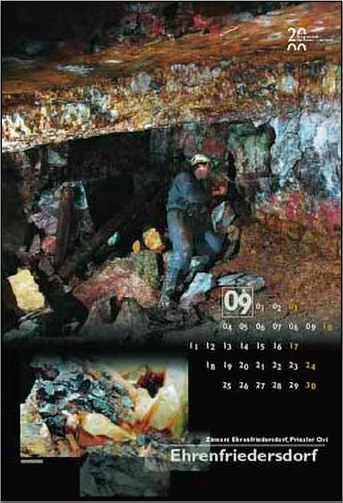
September · 2000
Tin ore in the Prinzler Ost workings
The September sheet documents an underground chamber in the Ehrenfriedersdorf tin mine. The original caption names the Prinzler Ost section; a miner stands between the colour-banded roof and the broken rock underfoot. Below is a specimen of quartz and fluorite. It belongs to the Mineralogical Collection of TU Bergakademie Freiberg, bears collection number 43213 and is reproduced at a stated width of 7.5 centimetres.
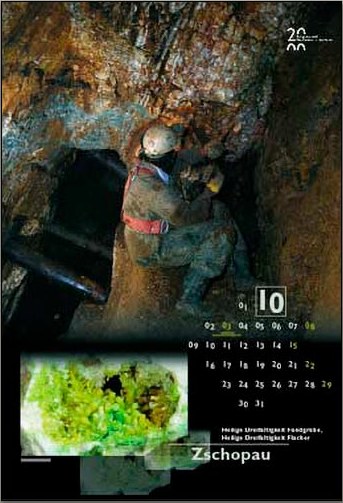
October · 2000
Heilige Dreifaltigkeit mine near Zschopau
In October, a miner is shown beside a strongly articulated rock surface in the Heilige Dreifaltigkeit mine near Zschopau. The Heilige Dreifaltigkeit Flacher vein is named as the precise find area. The underground photograph is paired with a specimen of pyromorphite and barite from the Mineralogical Collection of TU Bergakademie Freiberg. It bears number 79239 and is shown at a stated width of 3.0 centimetres.
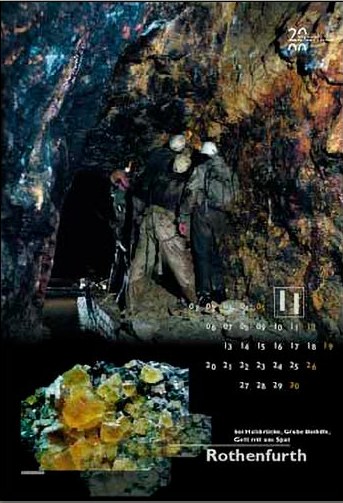
November · 2000
Beihilfe mine near Rothenfurth
The November motif shows two miners in a vividly mineralised chamber of the Beihilfe mine near Rothenfurth, close to Halsbrücke. The original caption assigns the find to the Gott mit uns Spat vein. A specimen of fluorite and galena appears in the lower part of the design. It comes from the Mineralogical Collection of TU Bergakademie Freiberg, bears number 55418 and is shown at a stated width of 10.0 centimetres.

December · 2000
St. Erasmus adit in Glashütte
The December sheet closes the year with historic underground workings in the St. Erasmus adit near Glashütte. A person in a red top stands at the end of the pale, irregularly excavated passage, conveying its dimensions. The Neue Hoffnung Stehender vein is recorded as the precise location. The white aragonite specimen below comes from a private collection and measures 7.0 × 3.5 centimetres according to the original information.


