
CALENDAR ARCHIVE / 2008
Mining Calendar 2008 – Historical Mine Winding Installations
The 15th Original Saxon Mining Calendar presents historical winding installations from ore, fluorspar, limestone and coal mining. Hand windlasses, horse whims, reversible waterwheels, turbine installations, steam engines and electric winding engines document the development of mine haulage.
This archive contains the cover, foreword sheet, twelve monthly pages and explanatory sheet with image descriptions. The complete introduction from the original edition is also available as readable text in English translation.
15th edition · 15 calendar pages · Photographs and foreword: Jens Kugler · Design: René König / Moxxo
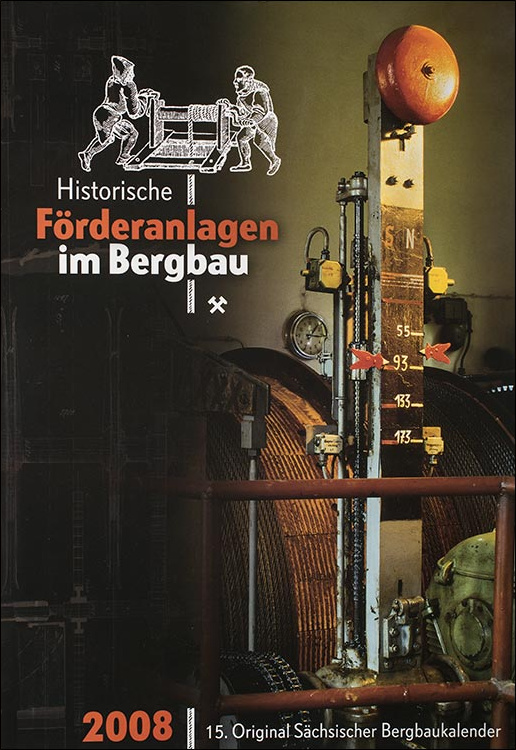
COVER · 2008
Hauptschacht Schönbrunn – Flussspatbergbau
The cover shows the winding engine of the main shaft at Schönbrunn in fluorspar mining. Its cable drum, controls and depth indicator introduce the theme of historical mine winding installations.

FOREWORD · 2008
Windlass worker by Christoph Weigel
The foreword sheet shows a windlass worker from Christoph Weigel’s “Abbildung und Beschreibung derer sämtlichen Bergwerks- und Schmelzhüttenbeamten und Bedienten nach ihrem gewöhnlichen Rang und Ordnung im behörigen Berghabit …”, published in 1721. Beneath the illustration is the complete introduction to historical mine winding installations, reproduced below in English translation.
English translation of Jens Kugler’s original German introduction. Historical information reflects the 2008 edition.
Historical Mine Winding Installations
Mine haulage brought extracted raw materials and large quantities of waste rock to the surface, while support materials and tools were taken underground. Transporting people was also part of mine haulage.
Until the end of the Middle Ages, underground haulage in Saxony generally used small, offset shafts, up to 30 metres deep, equipped with hand windlasses. Only the construction of continuous main shafts, documented in Erzgebirge ore mining from the fifteenth century, made it possible to use powerful technical installations. Horse whims and reversible waterwheels were followed by water-column engines, turbines, steam engines and finally electric winding engines. The use of powerful but also expensive machinery was driven by increasing depth and the steadily growing quantity of material to be transported.
The development of mine winding technology reached its peak in the deep, high-capacity shafts of Saxon coal mining and in uranium mining extending to depths of 2,000 metres.
Winding engines used and developed in Saxon mining were often considered the largest and most powerful machines of their time. Only a few original installations survive from the countless winding engines of Saxon mining. Particularly when preserved together with shaft buildings and headframes, they form historical ensembles that must be protected for future generations.
Some winding installations from Saxon ore mining, including a hand-windlass installation in Brand-Erbisdorf and the horse whims in Johanngeorgenstadt and Marienberg, have been rebuilt at full scale as visitor attractions.
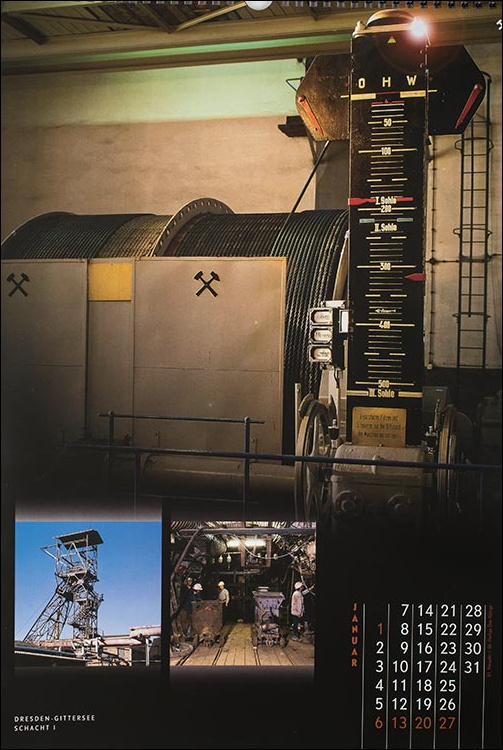
JANUARY · 2008
Schacht I – Dresden-Gittersee
Dresden-Gittersee, uranium mining, Shaft I: the upper photograph shows the winding engine. The smaller photograph on the left shows the headframe of Shaft I, while the one on the right shows the shaft station on the first level.
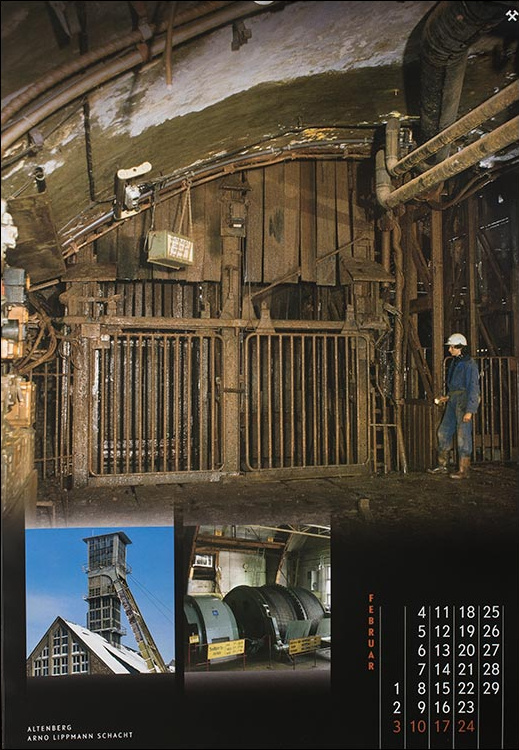
FEBRUARY · 2008
Arno-Lippmann-Schacht – Altenberg
Altenberg, tin mining, Arno-Lippmann-Schacht: the main photograph shows the shaft station on the seventh level. The headframe appears at bottom left and the shaft’s direct-current winding engine at bottom right.
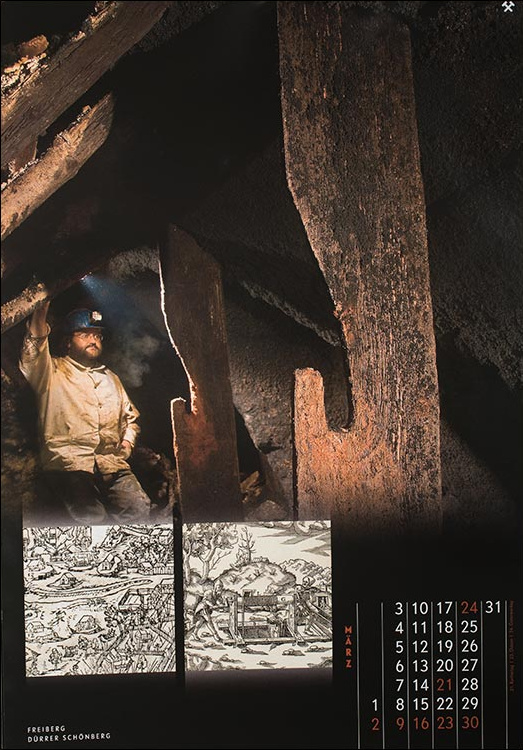
MARCH · 2008
Dürrer Schönberg – Freiberg
Freiberg, silver mining, stepped shaft of the Dürrer Schönberg mine: the upper photograph shows windlass remains from the first third of the sixteenth century. At bottom left is a mining landscape showing Dürrer Schönberg in the second half of the sixteenth century, from S. Münster’s “Cosmographie” (1550/1615). At bottom right is a hand windlass from Georgius Agricola’s “De re metallica” (1558).
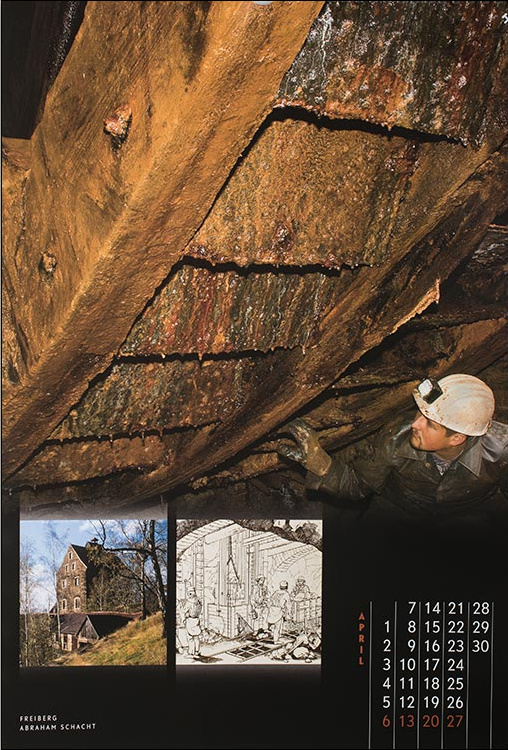
APRIL · 2008
Abraham Schacht – Freiberg
Freiberg, silver mining, Abraham Schacht: the upper photograph shows the reversible waterwheel. The smaller images show the winding house on the left and a drawing of the shaft station by Heuchler on the right.

MAY · 2008
Steyer Schacht – Obergruna
Obergruna, silver mining, Steyer Schacht: the main image is Irenäus Backofen’s drawing of the turbine-driven winding installation, Freiberg Mining Archive, 40044-1 Generalrisse, B 19710. The original description refers to “Schätze aus dem Bergarchiv”, publications of the Saxon State Archives, series A, volume 7, 2008. At bottom left are the winding house and other surface buildings of Steyer Schacht at the Gesegnete Bergmanns Hoffnung mine. The image on the right shows the shaft station at the level of the water-supply channel.
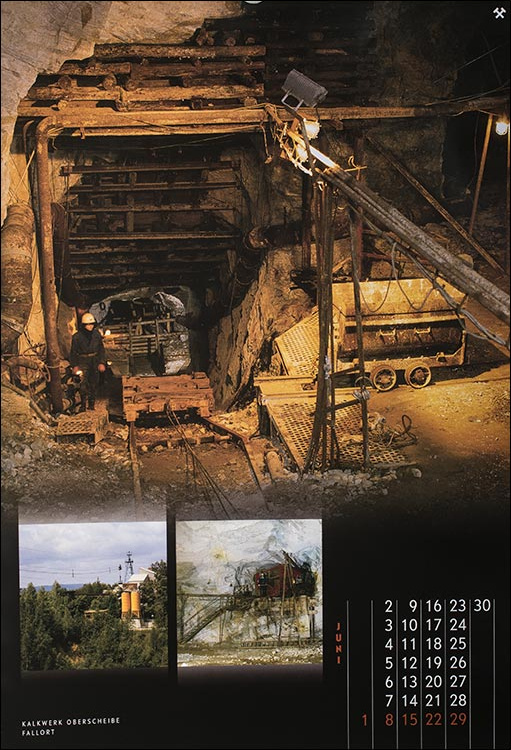
JUNE · 2008
Fallort – Kalkwerk Oberscheibe
Oberscheibe lime works, limestone mining, inclined shaft: the main photograph shows the incline to the fifth level. The cable-crane installation of the opencast workings appears at bottom left. The other photograph shows the winding engine serving the incline to the fifth level.
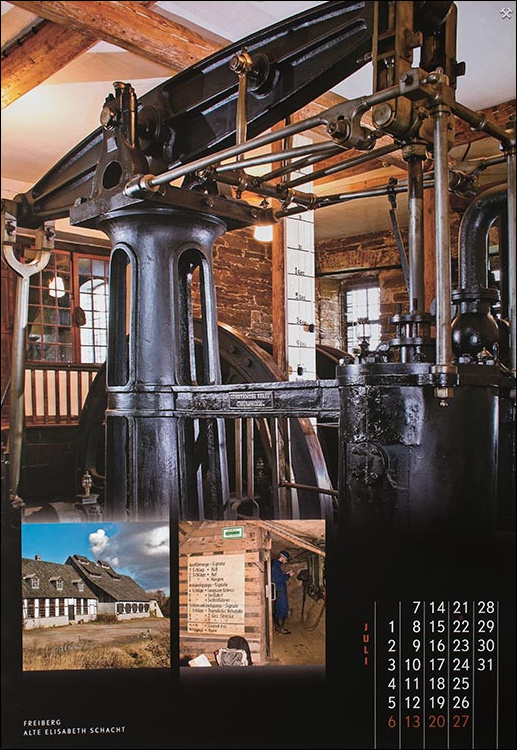
JULY · 2008
Alte Elisabeth Schacht – Freiberg
Freiberg, silver mining, Alte Elisabeth Schacht: the main photograph shows the steam winding engine built in 1848 by Constantin Pfaff of Chemnitz. At bottom left are the surface buildings of Alte Elisabeth Schacht at Himmelfahrt Fundgrube. The photograph on the right shows the shaft station at the level of the Thurmhofer Hilfsstolln.

AUGUST · 2008
Blindschacht II – Pöhla-Tellerhäuser
Pöhla-Tellerhäuser, uranium mining, Blindschacht II: the main photograph shows the underground shaft at the level of the Pöhla adit. The adit portal appears at bottom left, and the direct-current winding engine of Blindschacht II at bottom right.

SEPTEMBER · 2008
Rudolph Schacht – Marienberg-Lauta
Marienberg-Lauta, silver mining, Rudolph Schacht: the main photograph shows the horse whim. At bottom left it is demonstrated with animals. The image on the right shows Rudolph Schacht at the level of the Königlicher Weißtauber Stolln.

OCTOBER · 2008
Schacht 2 – Ehrenfriedersdorf
Ehrenfriedersdorf, tin mining, Shaft 2: the upper photograph shows the shaft station on the seventh level. At bottom left is the headframe of Shaft 2 at the Zinnerz Ehrenfriedersdorf mine. The image on the right shows the winding engine’s control console.
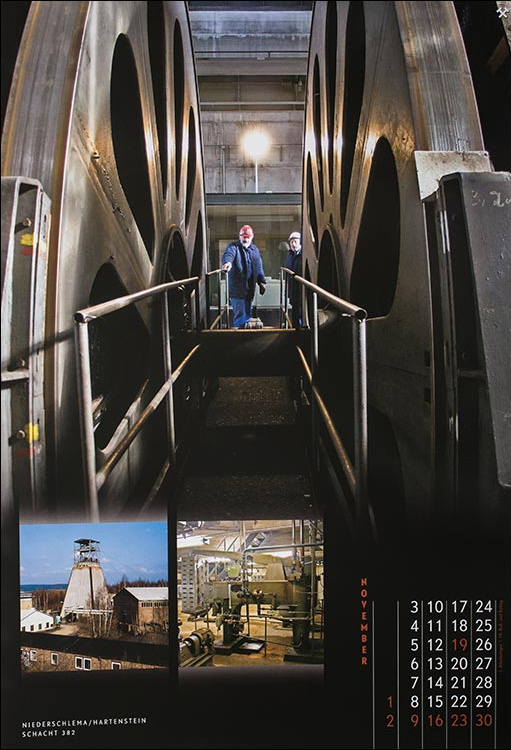
NOVEMBER · 2008
Schacht 382 – Niederschlema-Hartenstein
Niederschlema-Hartenstein, uranium mining, Shaft 382: the main photograph shows the winding engine. At bottom left is an overall view of the surface installations of Shaft 382, while the photograph on the right shows the winding engine’s braking mechanism.

DECEMBER · 2008
Kaiserin Augusta Schacht – Oelsnitz
Oelsnitz, coal mining, Kaiserin Augusta Schacht: the main photograph shows the shaft at night. At bottom left is the tower winding engine in Kaiserin Augusta Schacht. The image on the right shows an armoured conveyor in the underground section of the mining museum.

EXPLANATORY NOTES · 2008
Image descriptions and original imprint
The explanatory sheet identifies the historical winding installations and mining locations shown on the cover, foreword sheet and twelve monthly pages. It explains the individual image positions and includes the original imprint, crediting the concept, photographs, foreword, design and production.


