
CALENDAR ARCHIVE / 2009
Mining Calendar 2009 – Adits in Erzgebirge Mining
The 16th Original Saxon Mining Calendar explores adits in the Erzgebirge. Underground photographs show masonry, timber supports, water channels and secured shafts. Keystones and inscribed tablets complement the views of the workings.
This archive contains the cover, foreword sheet and twelve monthly pages with descriptions from the original edition. Jens Kugler’s complete introduction is also available as readable text in English translation.
16th edition · 14 calendar pages · Photographs and foreword: Jens Kugler · Design: René König / Moxxo
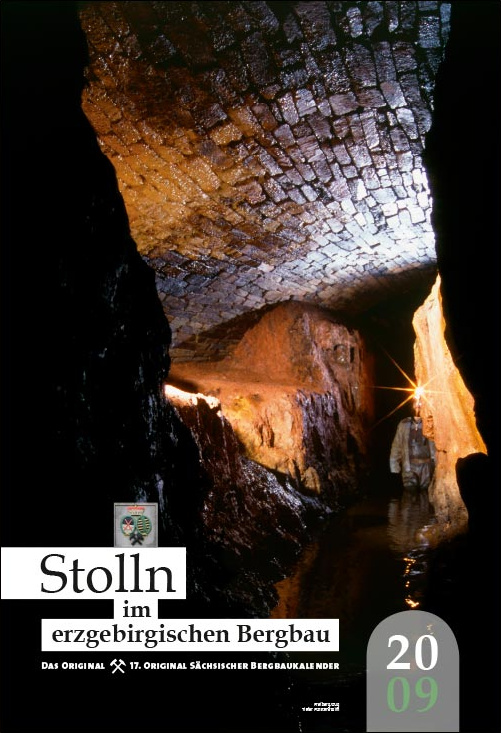
COVER · 2009
Tiefer Fürstenstolln – Freiberg/Zug
Freiberg/Zug: the cover shows roof protection in the Tiefer Fürstenstolln on the Hohe Birke Stehender vein near St. Niklas. The secured adit roof and underground space introduce the theme of adits in Erzgebirge mining.
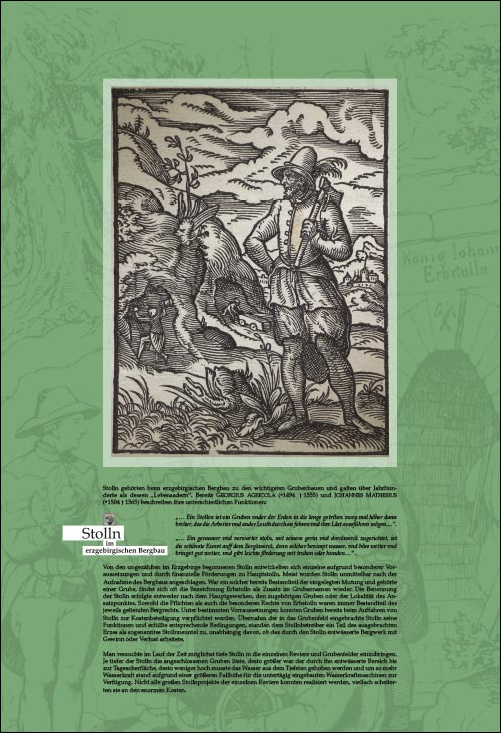
FOREWORD · 2009
The miner – Jost Amman, 1568
The foreword sheet shows “Der Bergknapp” by Jost Amman, dated 1568. Beneath the historical illustration is Jens Kugler’s introduction to the functions, rights and development of Erzgebirge adits. The complete text follows in English translation.
English translation of Jens Kugler’s original German introduction, including the historical quotations.
Adits in Erzgebirge Mining
Adits were among the most important workings in Erzgebirge mining and were regarded for centuries as its “lifelines”. GEORGIUS AGRICOLA (1494–1555) and JOHANNES MATHESIUS (1504–1565) already described their different functions:
“… An adit is a working driven lengthwise beneath the earth, twice as high as it is wide, so that workers and other people may travel through it and carry out their loads …”.
“… A spacious, secured adit, equipped with its drainage channel and haulage arrangements, is the finest installation in a mine, for it removes water and foul air, brings fresh air, and allows easy haulage with boxes or mine carts …”.
Of the countless adits begun in the Erzgebirge, some developed into principal adits thanks to favourable circumstances and financial support. Adits were generally started soon after mining began. If an adit was already part of the mining claim and belonged to a mine, the designation Erbstolln often appears as an addition to the mine’s name. Adits were named after the principal shareholder, the associated mines or the location of their starting point. Both the obligations and the special rights of hereditary drainage adits were always part of the mining law in force. Under certain conditions, mines could be required to contribute to the costs while an adit was still being driven. Once an adit reached a mining field, performed its functions and met the relevant conditions, its operator was entitled to a portion of the extracted ore, known as the Stollnneuntel, or adit ninth. This applied regardless of whether the mine drained by the adit operated at a profit or a loss.
Over time, miners tried to drive adits into individual districts and mining fields at the greatest possible depth. The deeper an adit drained the connected mines, the larger the drained area extending to the surface, the shorter the distance over which water had to be raised from the deepest workings, and the greater the water power available to underground water-powered machinery because of the increased head. Not all major adit projects in the various districts could be completed; many failed because of their enormous cost.
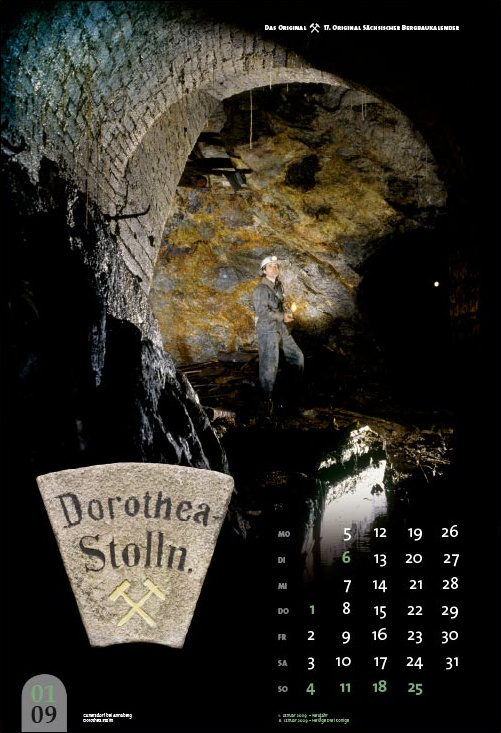
JANUARY · 2009
Dorothea Stolln – Cunersdorf bei Annaberg-Buchholz
Cunersdorf near Annaberg-Buchholz: a vein intersection secured with masonry on the Dorothea Morgengang in the Dorothea Stolln. The additional image shows the keystone at the adit portal.

FEBRUARY · 2009
Tiefer Sauberger Erbstolln – Ehrenfriedersdorf
Ehrenfriedersdorf: the box-shaped cross-section of the Tiefer Sauberger Erbstolln. The additional illustration shows the portal keystone at the Zinngrube Ehrenfriedersdorf museum.
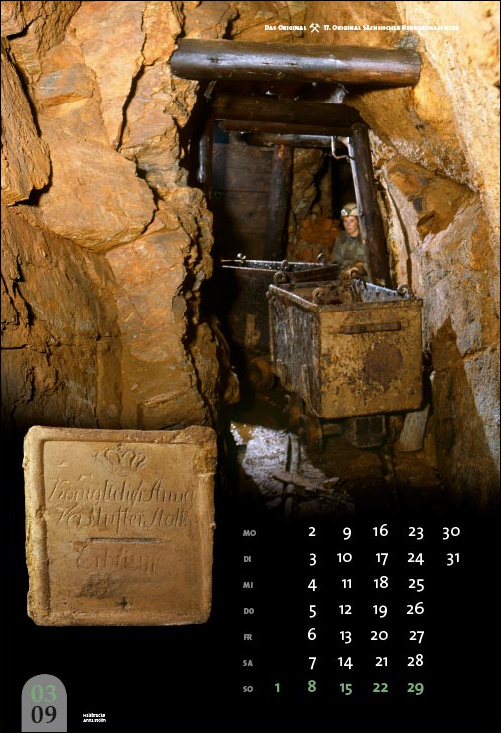
MARCH · 2009
Anna Stolln – Halsbrücke
Halsbrücke: a bypass working in the Muldenschacht area northwest of the Beihilfe Richtschacht, in the Anna Stolln, with mine carts and timber supports. The accompanying image shows the boundary tablet of the Verstufter Anna Stolln at Rheinisch Wein.

APRIL · 2009
Königlicher Markus Semmler Stolln – Niederschlema/Schneeberg
Niederschlema/Schneeberg: elliptical mine masonry in the Königlicher Markus Semmler Stolln, in the Michaeler bypass southwest of the Kornzeche. The smaller image shows the keystone at the adit portal.

MAY · 2009
Rothschönberger Stolln – Halsbrücke/Rothenfurth
Halsbrücke/Rothenfurth: roof protection and cast-iron water channels on a branch of the Rothschönberger Stolln on the Halsbrücker Spat vein. The accompanying image shows the tablet at the adit portal.
JUNE · 2009
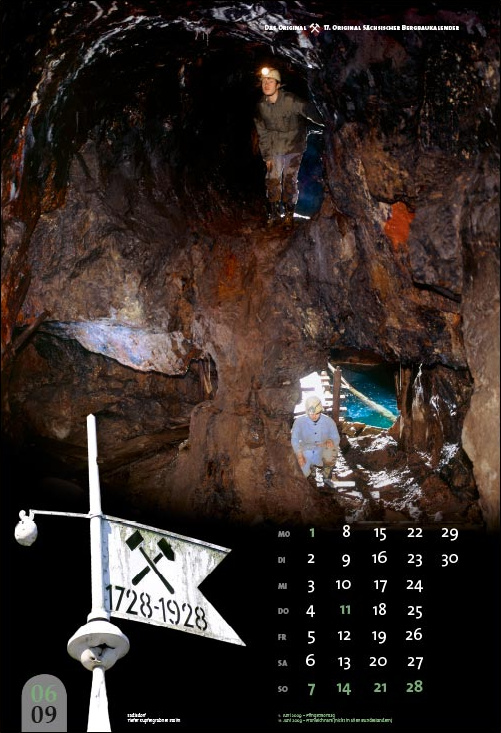
Tiefer Kupfergrübner Stolln – Sadisdorf
Sadisdorf: old stopes above the Tiefer Kupfergrübner Stolln. The underground photograph is accompanied by the weather vane at the adit portal.

JULY · 2009
Tiefer Blühend Glück Stolln – Pobershau/Hinterer Grund
Pobershau/Hinterer Grund: timber roof protection in the Tiefer Blühend Glück Stolln. The accompanying image shows the keystone at the adit portal.

AUGUST · 2009
Tiefer Hilfe Gottes Stolln – Obergruna/Kleinvoigtsberg
Obergruna/Kleinvoigtsberg: sidewall protection in the Tiefer Hilfe Gottes Stolln on the Vetter Michel Morgengang vein. The accompanying illustration shows the tablet at the Peter Fundschacht.

SEPTEMBER · 2009
Marie Louise Stolln – Berggießhübel
Berggießhübel: a passage excavated by fire-setting at the Mutter Gottes ore deposit in the Marie Louise Stolln. The additional image shows the keystone at the adit portal.

OCTOBER · 2009
Königlicher Verträgliche Gesellschaft Stolln – Freiberg
Freiberg: the Königlicher Verträgliche Gesellschaft Stolln on the Kirschbaum Stehender vein, with roof and floor protection. The accompanying image shows the inscribed tablet and keystone at the adit portal.
NOVEMBER · 2009
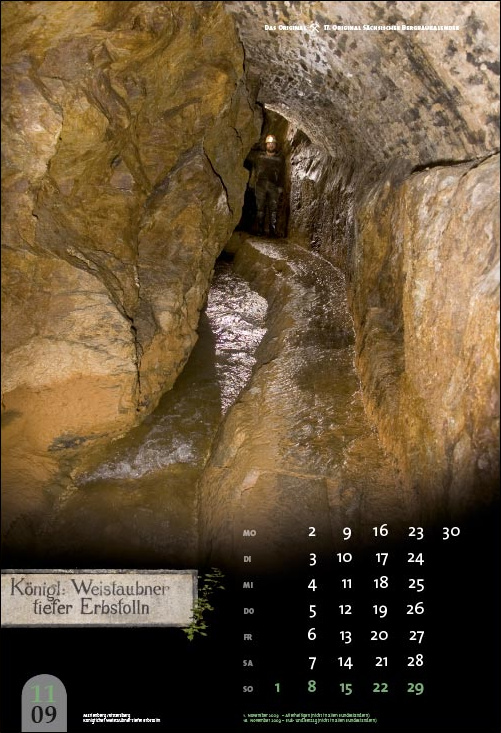
Königlicher Weistaubner tiefer Erbstolln – Marienberg/Rittersberg
Marienberg/Rittersberg: a drainage channel and roof protection in the Königlicher Weistaubner tiefer Erbstolln near the adit portal. The accompanying image shows the inscribed tablet at the portal.

DECEMBER · 2009
Griefner Stolln – Schneeberg-Neustädtel
Schneeberg-Neustädtel: a secured shaft in the Griefner Stolln on the Siebenhüfner Flacher vein. The smaller image shows the keystone at the adit portal.


