
CALENDAR ARCHIVE / 2013
Mining Calendar 2013 – Vein Images in Saxon Mining
The 20th Original Saxon Mining Calendar pairs underground photographs with vein images and selected collection specimens. Mineral associations, ores and host rocks reveal the variety of Saxon deposits. The original descriptions distinguish the photographed mine from the source of each specimen.
This archive contains the cover, foreword sheet, twelve monthly pages and explanatory sheet. Jens Kugler’s complete introduction is also available as readable text in English translation.
20th edition · 15 calendar pages · Photographs and foreword: Jens Kugler · Design: René König / Moxxo

COVER · 2013
Kühschacht Fundgrube and a vein specimen from Freiberg
Bräunsdorf: an open stope on the Morgengang near the Alter Kunstschacht at the level of the deep adit in Kühschacht Fundgrube, photographed in 2012. The accompanying specimen comes from Himmelfahrt Fundgrube, Wilhelm Stehender Nord, first level, Freiberg. It represents the quartz-polymetallic association, formerly the kiesig-blendige Bleierzformation (kb). TU Bergakademie Freiberg, Geoscientific Collections, inventory LaSa 49791; 13 × 6 cm.
FOREWORD · 2013
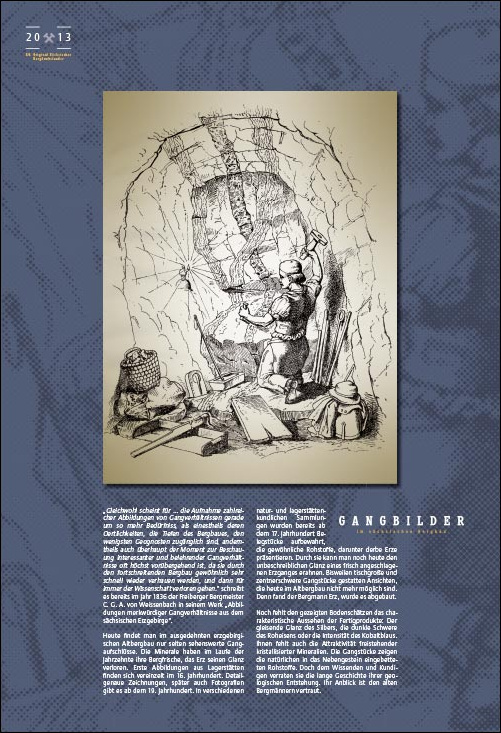
The piecework hewer – Eduard Heuchler
Eduard Heuchler’s “Als Gedinghäuer”, from “Bergmanns Lebenslauf”, Freiberg 1867. His illustration uses a vein exposure visible in 1821 on the Segen Gottes Stehender vein in an overhand stope above the first Gezeugstrecke level, 66 metres north of its intersection with the Wegweiser Spat, at Simon Bogners Neuwerk Fundgrube near Brand-Erbisdorf. The original reference is Weissenbach (1836), VIII/IX, figure 17.
English translation of Jens Kugler’s original German introduction, including the historical quotation. References to the present day reflect the 2013 edition.
“Nevertheless, there appears to be all the greater need for … numerous illustrations of vein relationships, since, on the one hand, their locations in the depths of the mines are accessible to very few geologists and, on the other, the opportunity to observe interesting and instructive vein relationships is often extremely fleeting. Advancing mining usually removes them again very quickly, and they are then lost to science for ever.” Thus wrote Freiberg mining official C. G. A. von Weissenbach in 1836 in his work “Abbildungen merkwürdiger Gangverhältnisse aus dem sächsischen Erzgebirge”.
Today, impressive vein exposures are only rarely found in the extensive old mines of the Erzgebirge. Over the decades, the minerals have lost their freshly mined appearance and the ore its lustre. A few early illustrations of deposits date from the sixteenth century. Detailed drawings, followed later by photographs, have existed since the nineteenth century. From the seventeenth century onwards, various natural-history and mineral-deposit collections preserved specimens representing common raw materials, including massive ores. They still give an impression of the indescribable lustre of a freshly exposed ore vein. Vein sections sometimes as large as a table and weighing a hundredweight or more provide views that are no longer possible in the old mines. For when miners found ore, they extracted it.
The mineral resources shown here do not yet have the characteristic appearance of the finished products: the brilliant shine of silver, the dark weight of pig iron or the intensity of cobalt blue. Nor do they have the appeal of freely formed mineral crystals. The vein specimens show the natural raw materials embedded in their host rock. Yet to the knowledgeable observer they reveal the long history of their geological formation. Their appearance was familiar to the miners of the past.
JANUARY · 2013
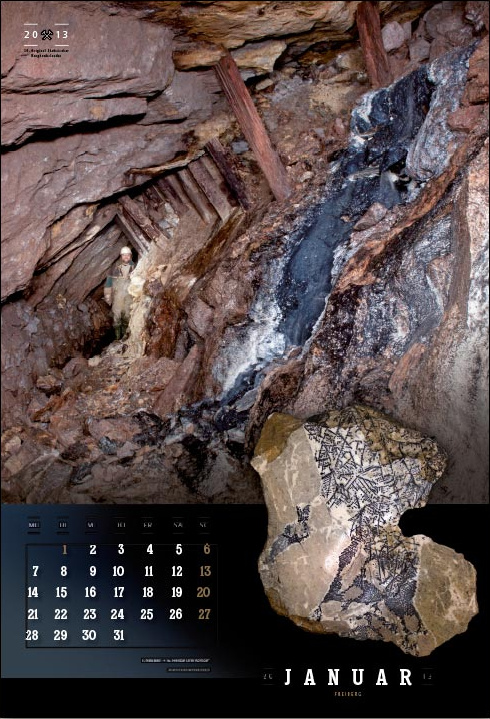
Himmelfahrt Fundgrube and argentite dendrites
Freiberg: a medieval adit with a waste-rock wall and timber roof structures near the Elende Seelen Neuschacht at Himmelfahrt Fundgrube, photographed in 2012. The specimen from Himmelfahrt Fundgrube shows argentite dendrites in brown spar and represents the carbonate silver-sulphide association, formerly Edle Braunspatformation (eb). TU Bergakademie Freiberg, Geoscientific Collections, inventory MiSa 4677; 36 × 26 cm.
FEBRUARY · 2013
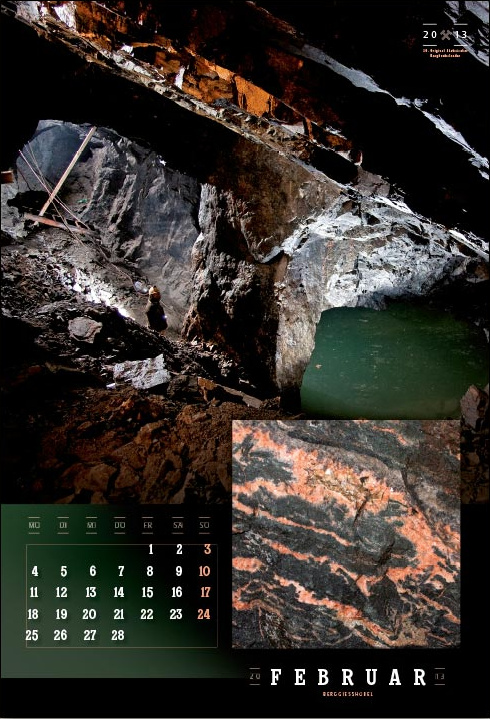
Marie Louise Stolln and magnetite
Berggießhübel: workings in the Mutter Gottes deposit below the Marie Louise Stolln, photographed in 2005. The accompanying vein image shows magnetite from the Mutter Gottes deposit at Marie Louise Stolln. The pictured section measures approximately 50 × 50 cm.
MARCH · 2013
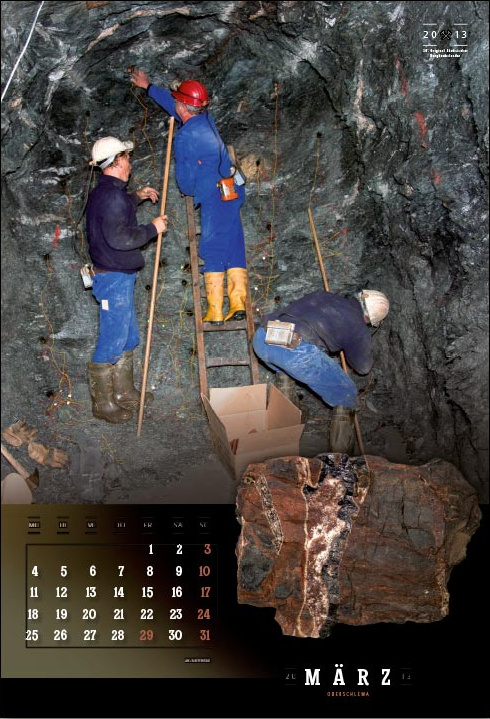
Markus Semmler Stolln and pitchblende
Oberschlema: new excavation of the ventilation crosscut towards Shaft 282 at the level of the Markus Semmler Stolln, photographed in 2005. The specimen is a pitchblende veinlet in host rock from Oberschlema, dated 1957. TU Bergakademie Freiberg, Geoscientific Collections, inventory LaSa 46065; 15 × 11 cm.
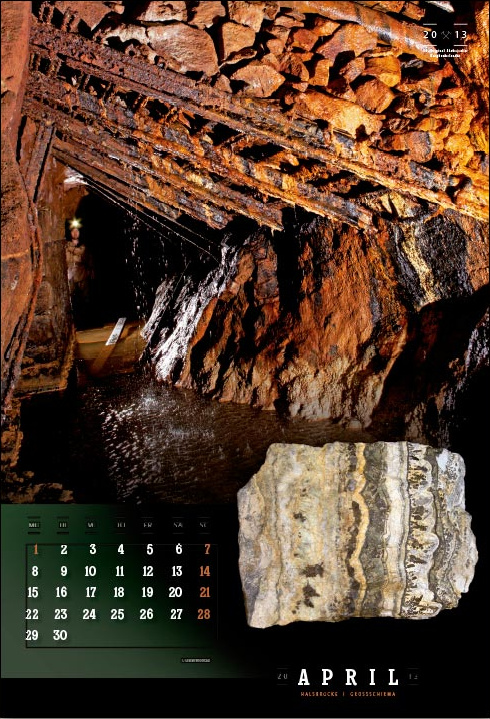
APRIL · 2013
Rothschönberger Stolln and Drei Prinzen Spat
Halsbrücke: timber roof protection on the Samuel Spat near the Beihilfer crosscut in the Verstufter Rothschönberger Stolln, leading into the Churprinz Friedrich August Erbstolln mining field, photographed in 2011. The specimen comes from Drei Prinzen Spat at Churprinz Friedrich August Erbstolln, Großschirma. It represents the fluorite-baryte lead-ore association, formerly Fluorbarytische Bleierzformation (fba). TU Bergakademie Freiberg, Geoscientific Collections, inventory LaSa 52999; 22 × 15 cm.
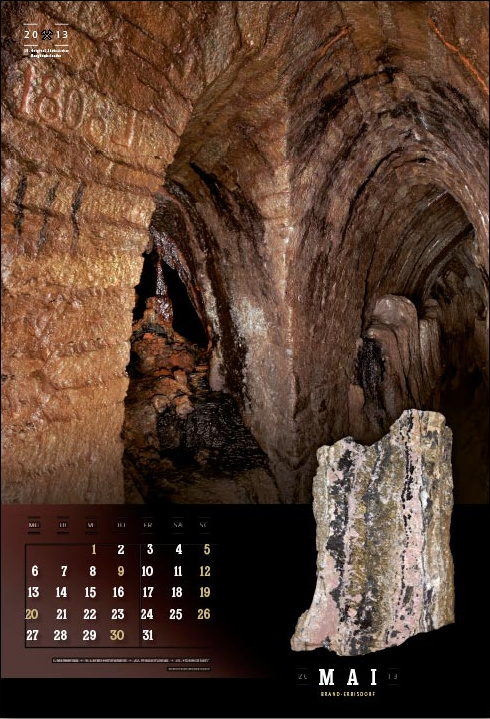
MAY · 2013
Thelersberger Stolln and Himmelsfürst
Brand-Erbisdorf: a vault in the Thelersberger Stolln on the Ludwig Stehender vein, photographed in 2011. The specimen comes from the Verborgen Flacher vein at Himmelsfürst Fundgrube, Brand-Erbisdorf, Himmelsfürst. It represents the carbonate silver-sulphide association, formerly Edle Braunspatformation (eb). TU Bergakademie Freiberg, Geoscientific Collections, inventory LaSa 52996; 21 × 14 cm.
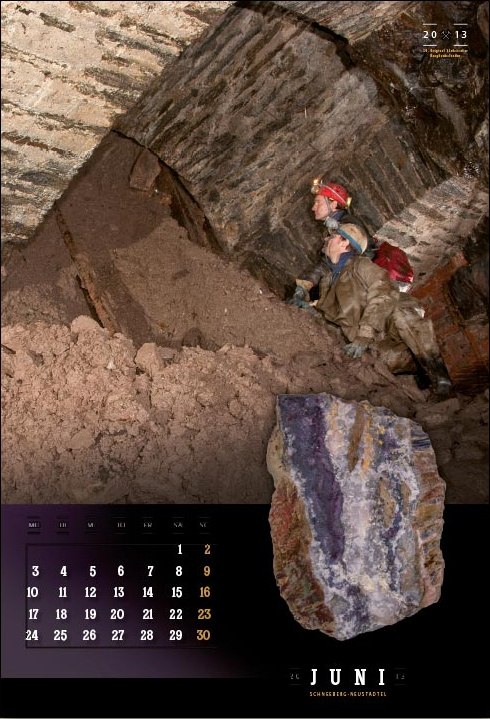
JUNE · 2013
Griefner Stolln and the BiCoNi association
Schneeberg-Neustädtel: the shaft station at Schindler Schacht in the Griefner Stolln, photographed in 2005. The specimen from Schneeberg represents the BiCoNi association, with cobalt arsenides, erythrite and quartz. TU Bergakademie Freiberg, Geoscientific Collections, LaSa; 12 × 8 cm.
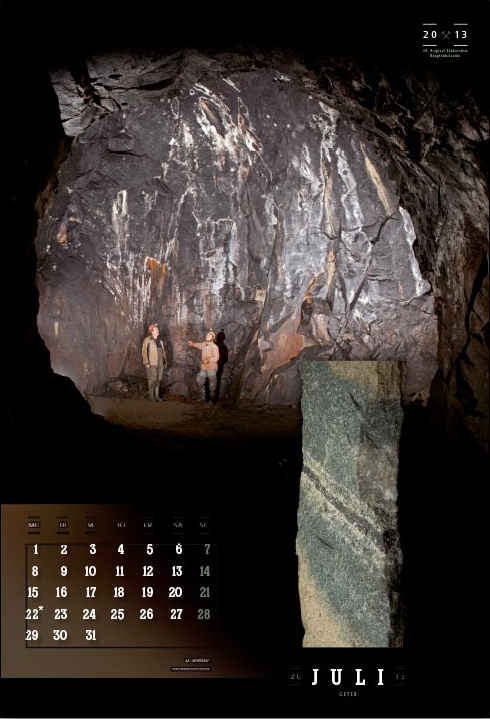
JULY · 2013
Weiße Zeche and a cassiterite vein
Geyer: a fire-set chamber at Weiße Zeche, photographed in 2012. The specimen from Geyer shows a cassiterite vein with greisen alteration zones in granite. TU Bergakademie Freiberg, Geoscientific Collections, inventory LaSa 36610; 60 × 15 cm.
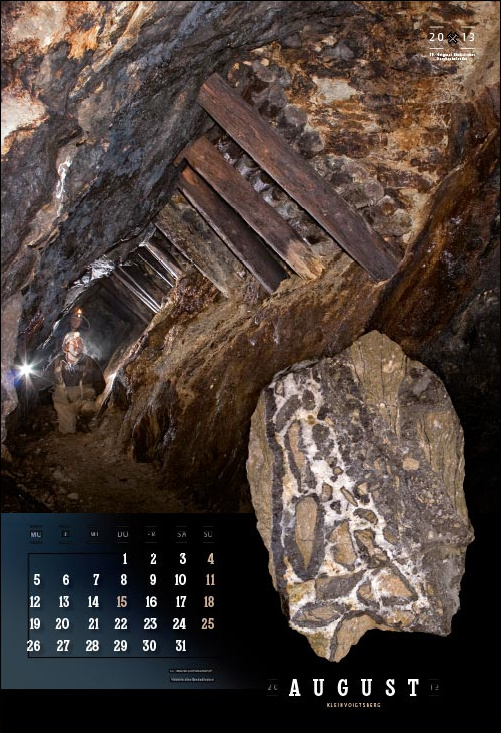
AUGUST · 2013
Alte Hoffnung Gottes and vein breccia
Großschirma, Kleinvoigtsberg: timber roof protection in the Tiefer Alte Hoffnung Gottes Stolln on the Frischglück Stehender vein at Alte Hoffnung Gottes Erbstolln, photographed in 2009. The specimen is a vein breccia, or cockade ore, combining the quartz-polymetallic and carbonate silver-sulphide associations, formerly jointly described as Edle Quarzformation (eq). TU Bergakademie Freiberg, Geoscientific Collections, LaSa; 27 × 18 cm.
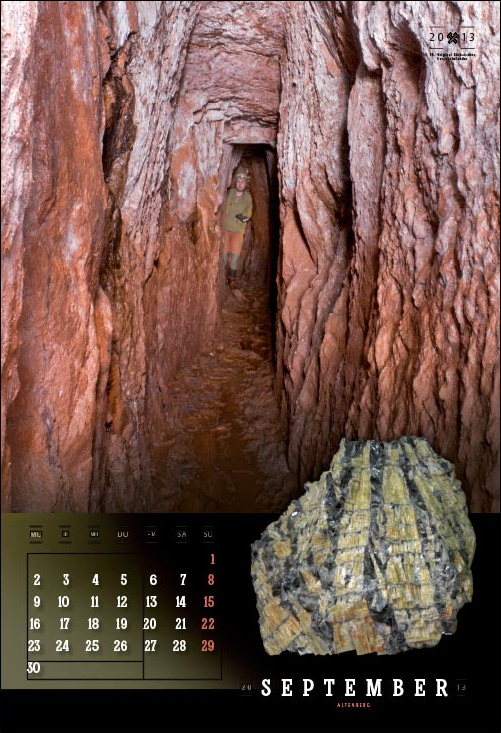
SEPTEMBER · 2013
Rothbärtner Stolln and Stockscheider pegmatite
Altenberg: a hand-hewn passage in the Rothbärtner Stolln, photographed in 2012. The specimen from the Altenberg tin mine is a topaz-altered Stockscheider pegmatite (pyknite). TU Bergakademie Freiberg, Geoscientific Collections, inventory LaSa 36572; 20 × 20 cm.
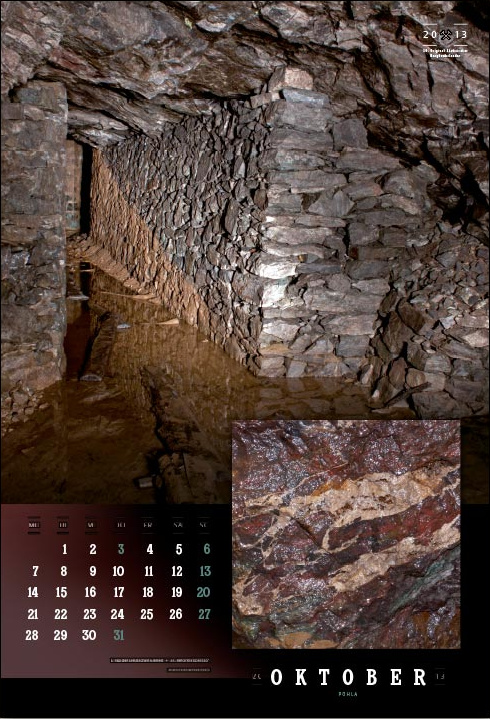
OCTOBER · 2013
Neue Silberhoffnung and skarn mineralisation
Pöhla: waste-rock walls in the Neue Silberhoffnung mine at adit level on Flacher 1, photographed in 2012. The accompanying image shows skarn mineralisation at Neue Silberhoffnung, Pöhla. The field of view is approximately 70 cm wide.
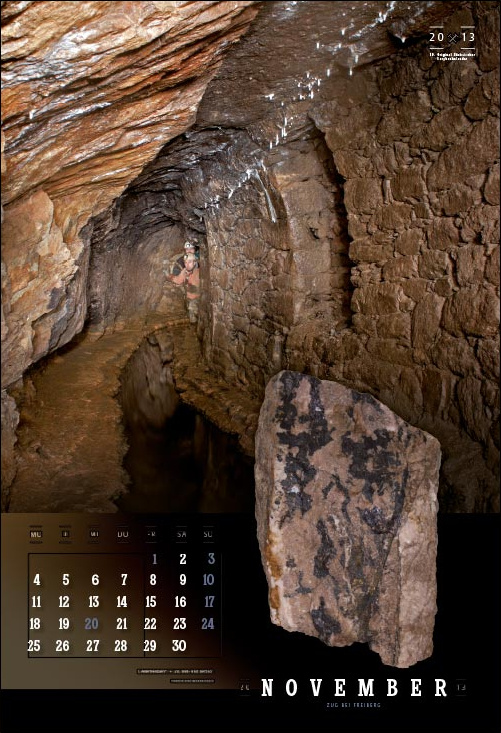
NOVEMBER · 2013
Beschert Glück and the silver-sulphide association
Freiberg, Zug: a stope with an ore chute and backfill wall at the level of the Churfürst Johann Georgen Stolln on the Beschert Glück Stehender vein in the Beschert Glück mine, photographed in 2012. The specimen from Beschert Glück Fundgrube represents the carbonate silver-sulphide association, formerly Edle Braunspatformation (eb). TU Bergakademie Freiberg, Geoscientific Collections, LaSa; 16 × 10 cm.
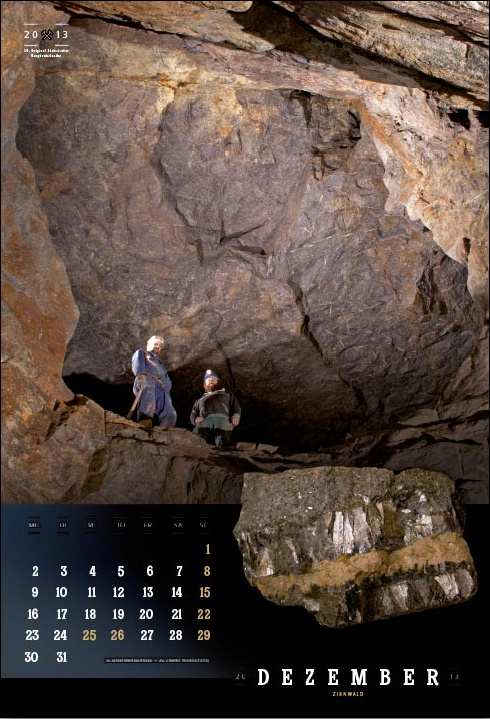
DECEMBER · 2013
Reichtroster Weitung and a flat-lying vein
Zinnwald: workings in the Reichtroster Weitung below the Tiefer Bünau Stolln, photographed in 2010. The specimen from Zinnwald shows a flat-lying vein with quartz and zinnwaldite. TU Bergakademie Freiberg, Geoscientific Collections, LaSa; 25 × 16 cm.
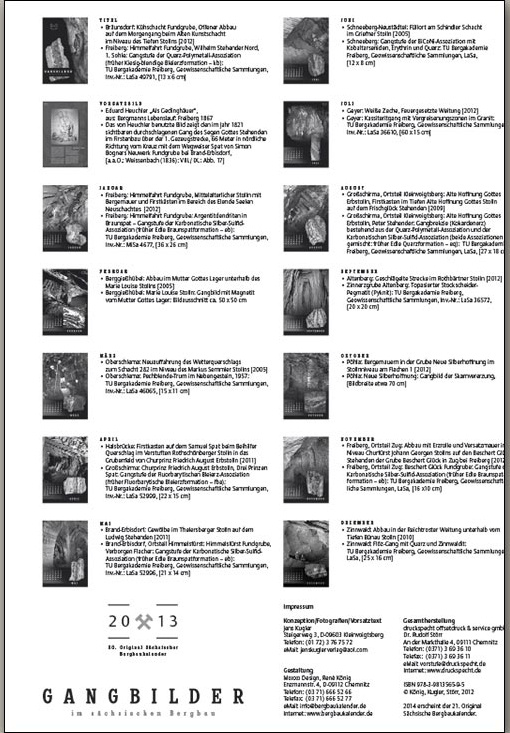
EXPLANATORY NOTES · 2013
Image descriptions and original imprint
The explanatory sheet identifies the underground photographs, vein images and collection specimens. It records photograph dates, mineral associations and historical formation names, dimensions, inventory numbers and collection credits. The original imprint names the concept, photographs, foreword, design and production.


