
The world of minerals · History and calendar archive
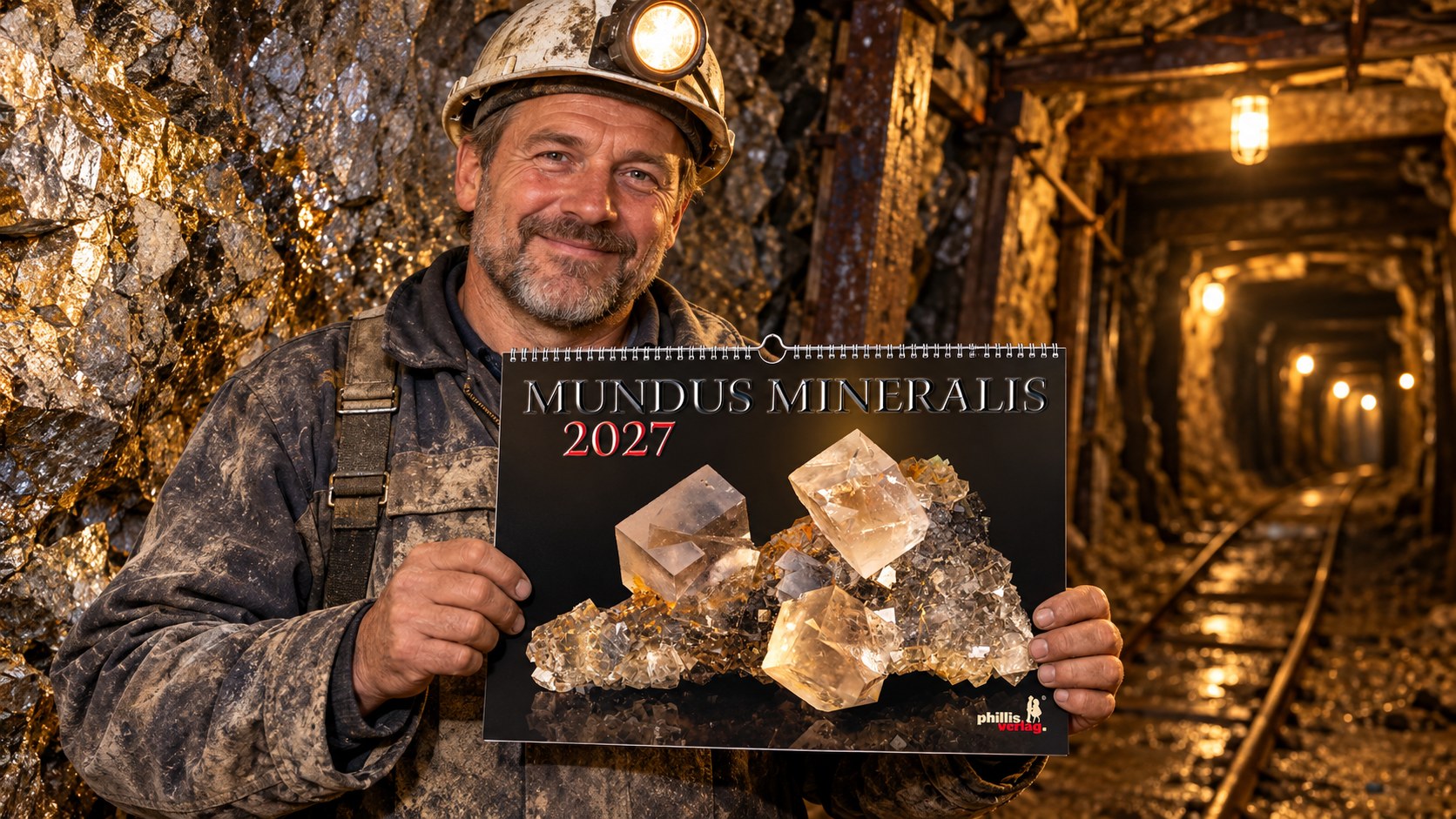
Crystals, colours and forms in close-up: Mundus Mineralis combines expressive mineral photography with information about the specimens shown. Discover the calendar series and its editions here, starting with 2027.
Mundus Mineralis – minerals as photographic subjects
The name Mundus Mineralis means “the world of minerals”. Published by PhillisVerlag, the calendar focuses on selected mineral specimens and their extraordinary forms. Large photographs, dark backgrounds and carefully controlled lighting give each subject space: crystal faces gleam, fine structures become visible, and even small specimens make a striking impression.
This combination of mineralogy and photography defines the series. The images invite a closer look, whether you already collect minerals or are discovering their diversity for the first time. Captions on the monthly pages identify the minerals, their chemical composition, localities and the collections to which they belong.
The history: roots in the 2013 calendar
The origins of the present series go back to the 2013 calendar. The early editions were titled Terra Mineralia and presented minerals from the Freiberg collection. The publisher’s description of the 2015 edition refers to the two preceding calendars for 2013 and 2014. The title Mundus Mineralis is documented for 2015.
The new title broadened the focus beyond Freiberg: alongside specimens from terra mineralia, minerals from other collections were introduced. For more than a decade, the series has combined the fascination of major museum collections with remarkable specimens from other sources. The 2027 pages shown here continue this diversity with examples from museum and private collections.
A wall calendar for looking closer and discovering more
The publisher describes the calendar as A3 landscape format, measuring 42 × 29.7 centimetres, with spiral binding. Features include a calendar with German festivals and public holidays, together with an accompanying postcard series. Information on visitor mines and mineralogical collections complements the edition, maintaining a connection with the places where minerals are found, preserved and exhibited.
Part of the appeal for mineral enthusiasts lies in comparison: how do colours, surfaces and forms differ? Which localities appear again? This archive preserves the images beyond each calendar year and gradually brings the series together as a continuous collection.
2027 EDITION
Mundus Mineralis 2027
From the Vogtland through Chemnitz and the Ore Mountains to the Harz and China, these photographs feature minerals from a range of localities. The archive currently includes the cover and monthly pages from June to December. January to May will be added.
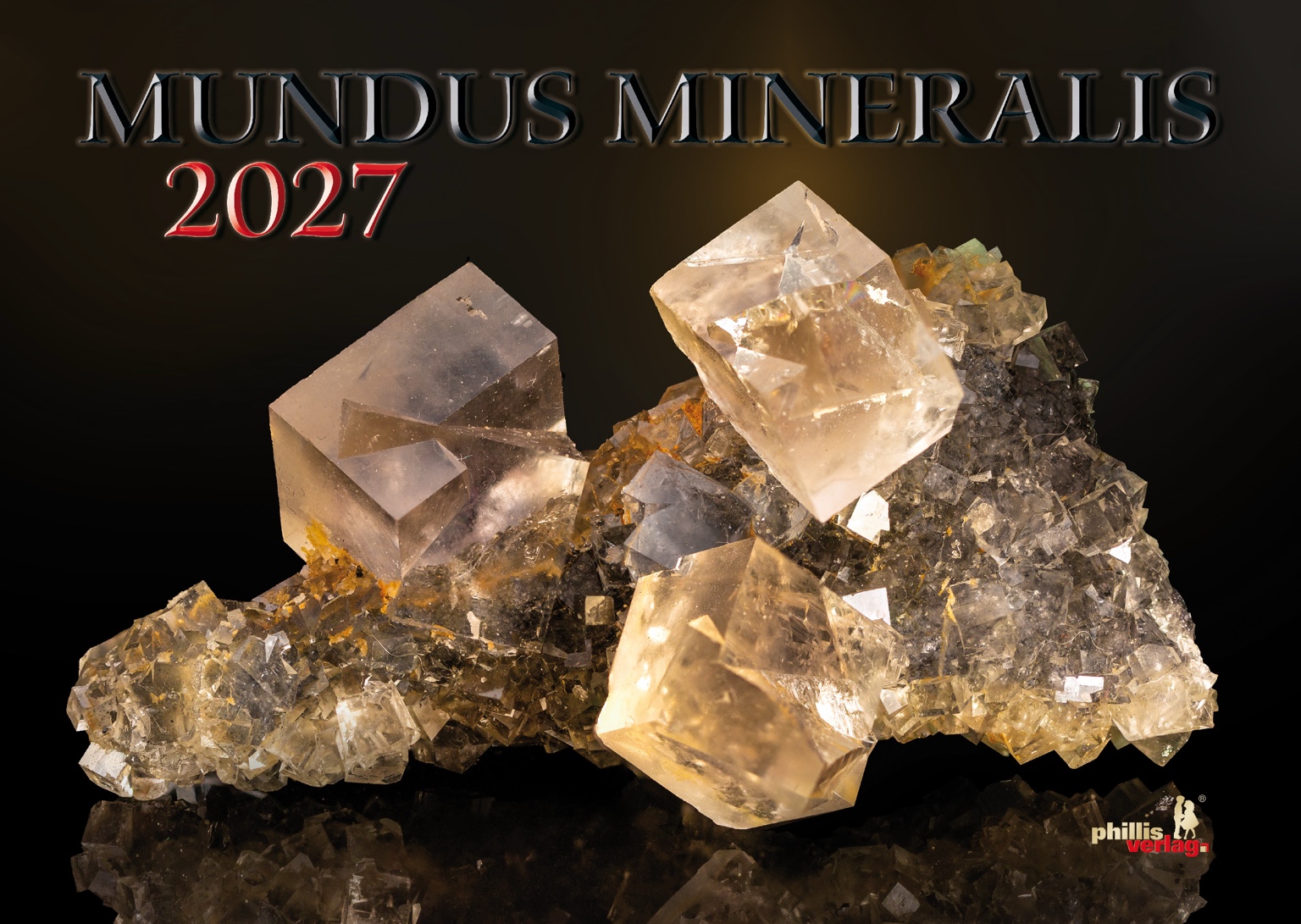
Cover 2027
Light, transparency and crystal forms
Large translucent crystals in warm honey and pale grey tones dominate the cover. Smaller crystals surround the prominent forms, while highlights and reflections against the dark background emphasise their three-dimensional shape. The cover captures the photographic character of the series. No mineral name, locality or collection is specified on this cover.

June 2027
Uranocircite from the Vogtland
Bright yellow-green to green crystal plates overlap in dense, fan-shaped groups. The photograph reveals their fine layers and different orientations. Brown areas provide a strong contrast with the vivid green.
Locality: Bergen granite quarry, Vogtland, Saxony, Germany. Collection: Tonik Güttler, Eppendorf.
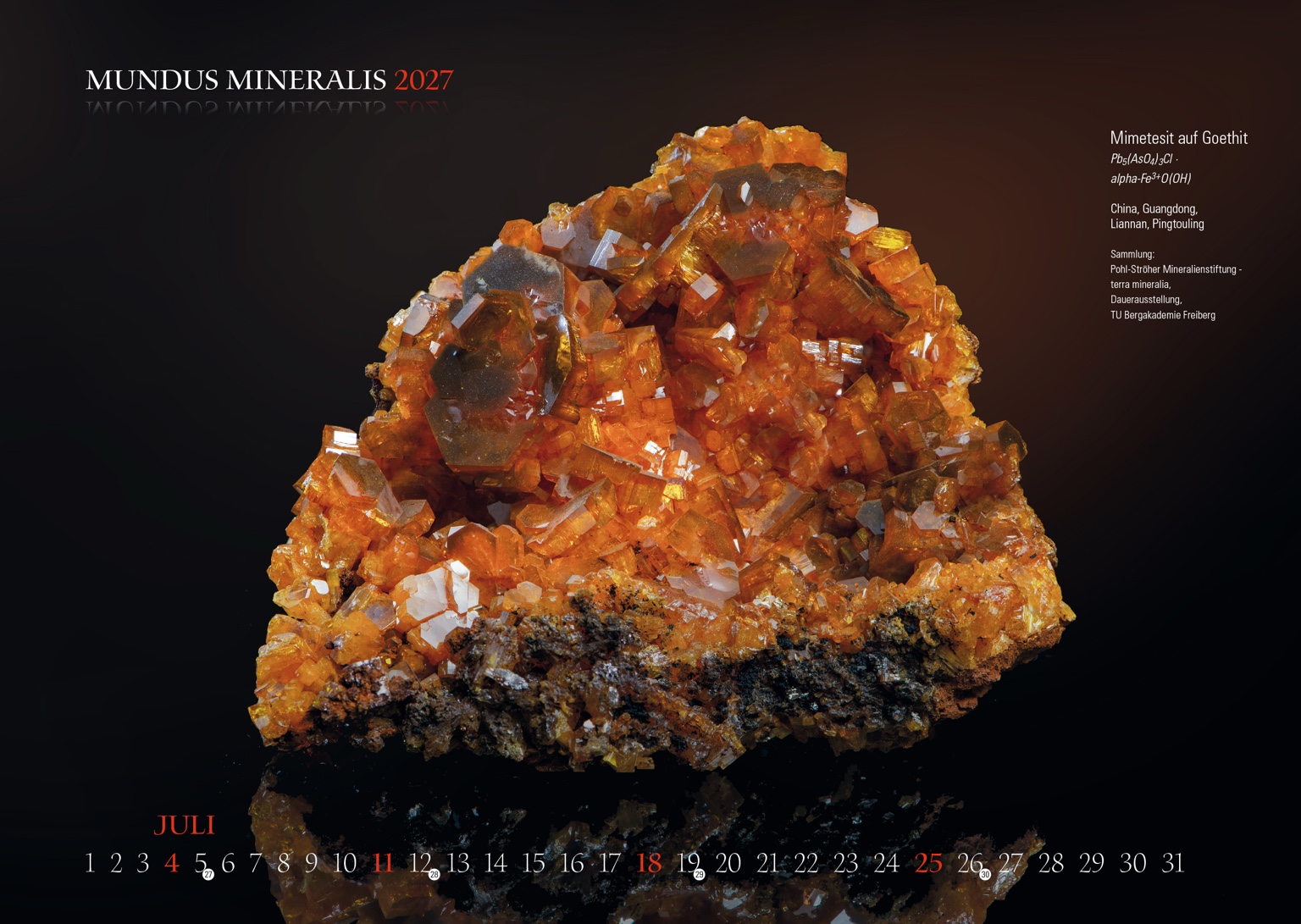
July 2027
Mimetite on goethite from China
Orange to honey-coloured mimetite crystals cluster closely on dark goethite. Shiny faces and crystal centres that appear darker in places give the specimen depth. The black background emphasises the warm colours of the group.
Locality: Pingtouling, Liannan, Guangdong, China. Collection: Pohl-Ströher Mineralienstiftung – terra mineralia, permanent exhibition at TU Bergakademie Freiberg.
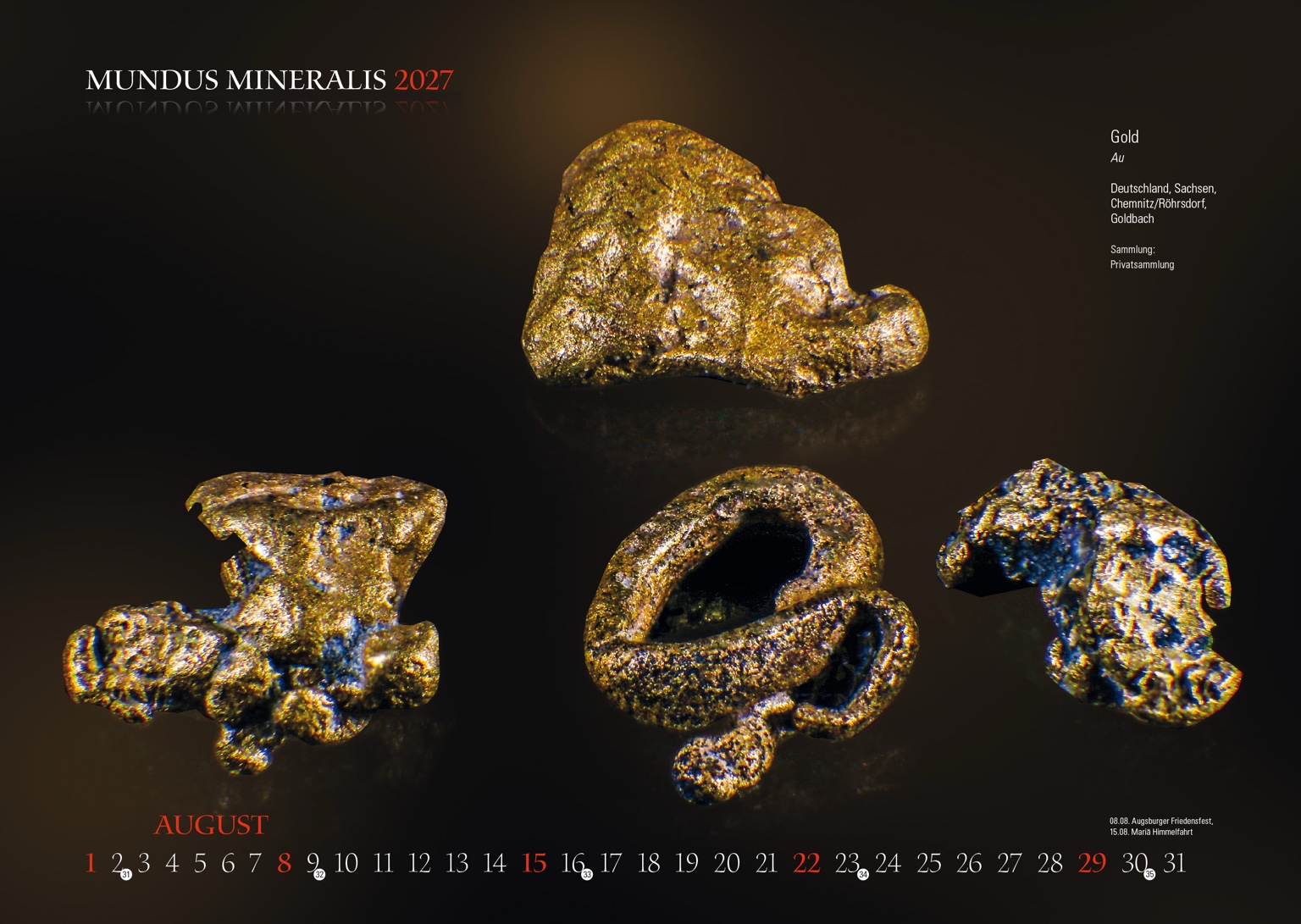
August 2027
Gold from Chemnitz-Röhrsdorf
Four irregularly shaped pieces of gold show how varied a single material can look. Their surfaces are rough, folded in places or marked by hollows. The close-up turns their small forms and metallic lustre into individual photographic subjects.
Locality: Goldbach, Chemnitz/Röhrsdorf, Saxony, Germany. Collection: private collection.
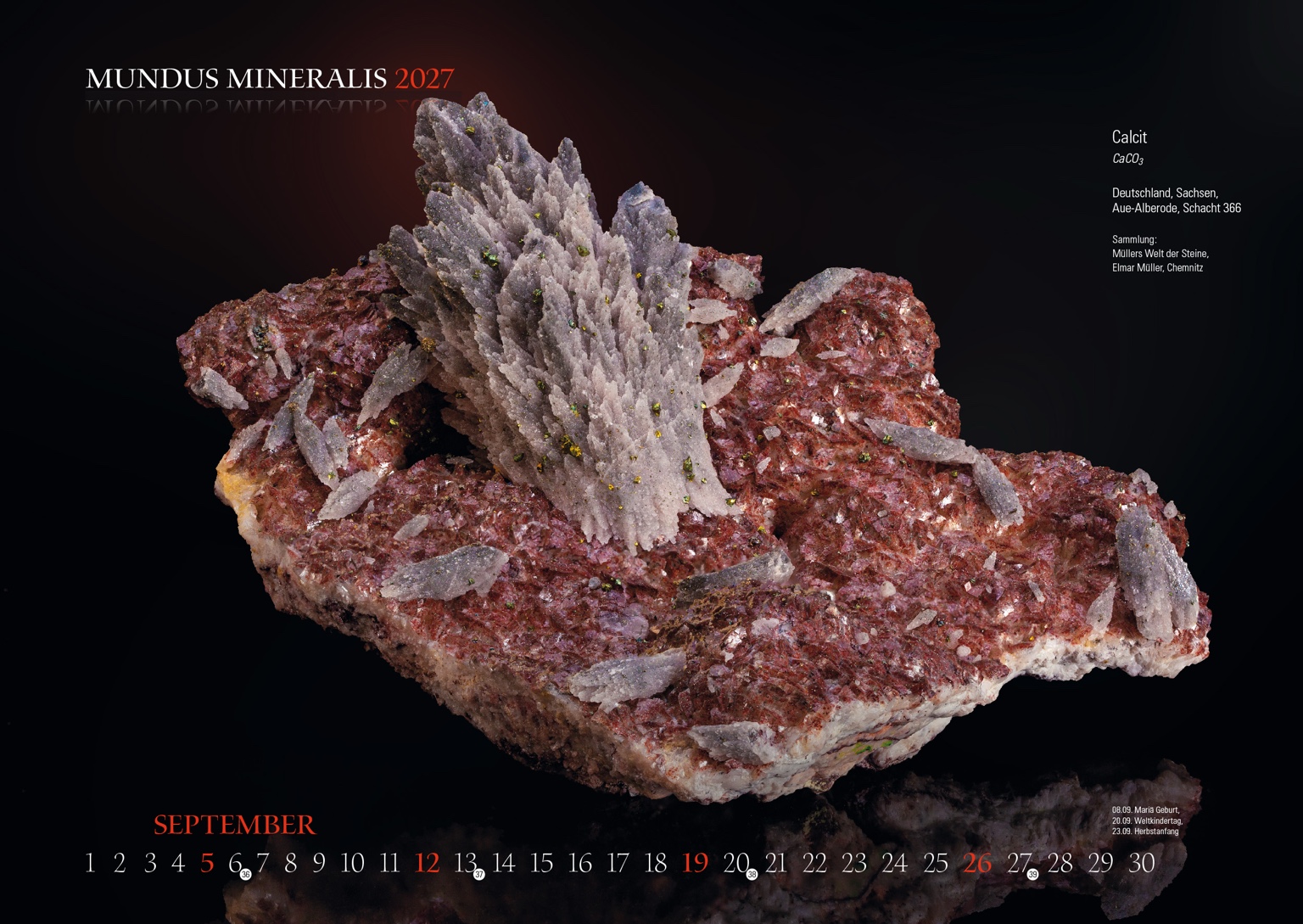
September 2027
Calcite from Aue-Alberode
A pale, fan-like calcite formation rises from a reddish-brown matrix. Numerous tiny crystal faces give its surface an almost frosted appearance. Other elongated pale crystal groups extend across the specimen, with small sparkling points adding further detail.
Locality: Shaft 366, Aue-Alberode, Saxony, Germany. Collection: Müllers Welt der Steine, Elmar Müller, Chemnitz.
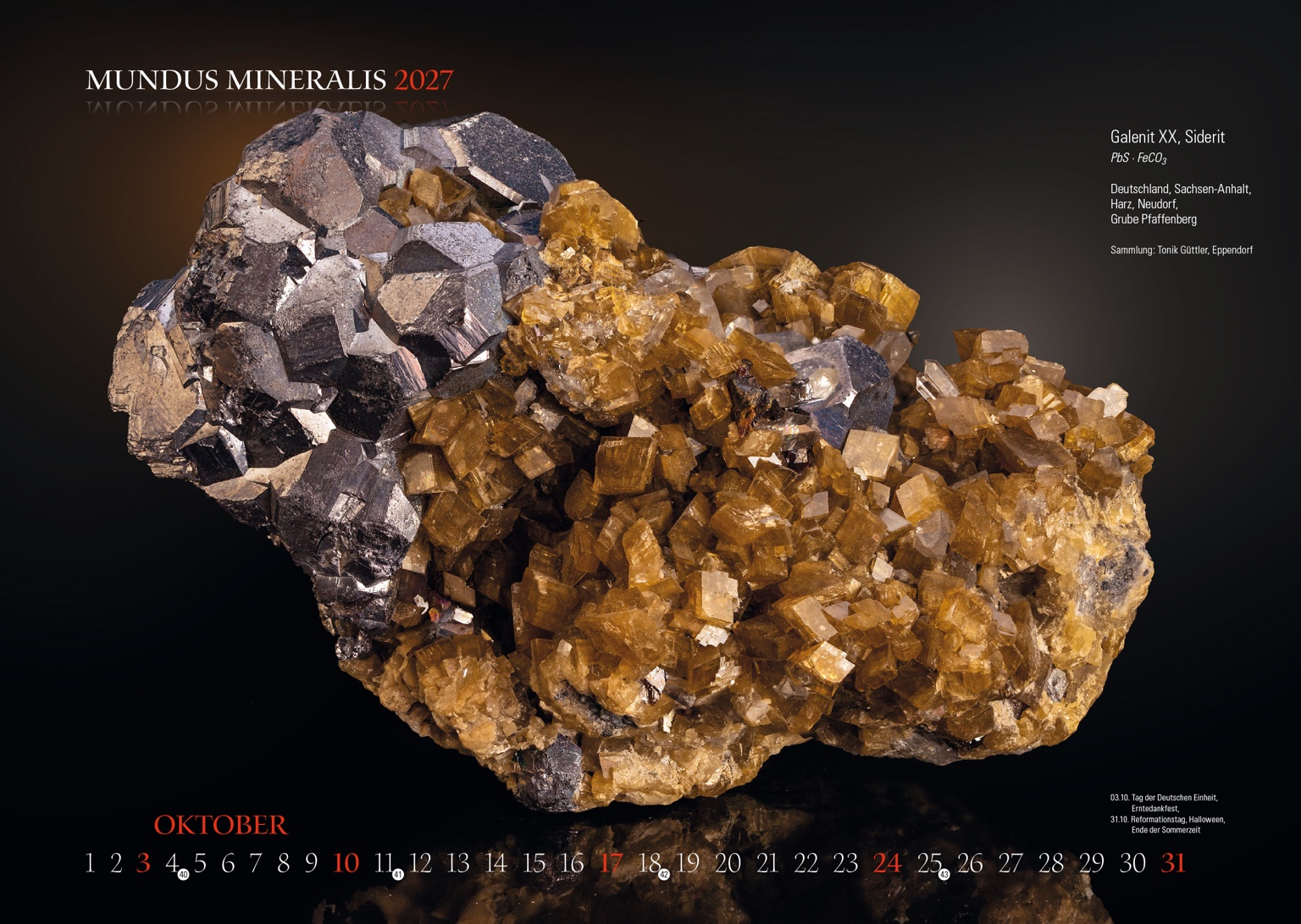
October 2027
Galena and siderite from the Harz
Grey galena crystals with a metallic lustre meet numerous honey-brown siderite crystals. The large, clearly defined faces on the left and the smaller warm-coloured crystals on the right reveal the contrast between metallic reflections and translucent areas.
Locality: Pfaffenberg mine, Neudorf, Harz, Saxony-Anhalt, Germany. Collection: Tonik Güttler, Eppendorf.
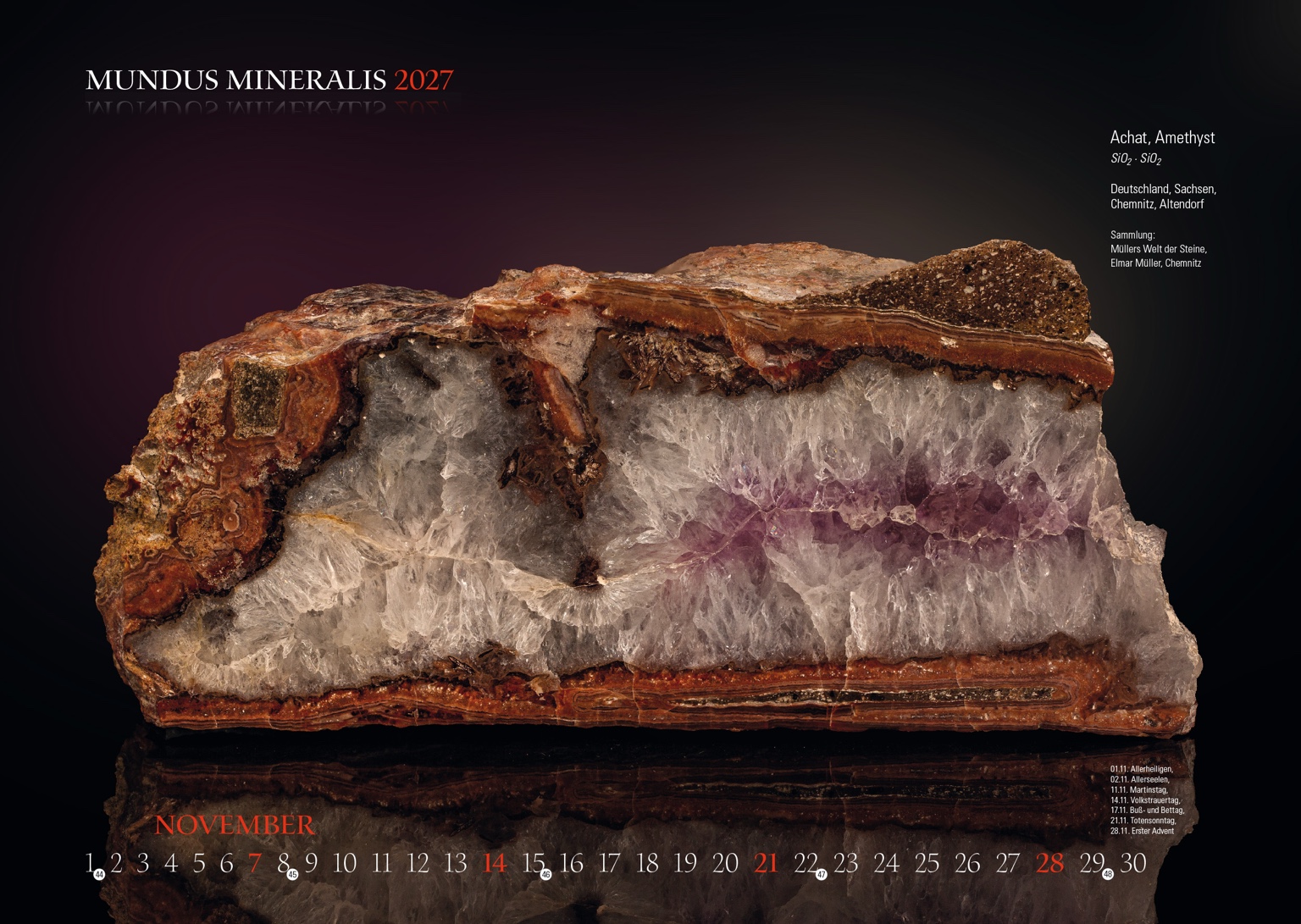
November 2027
Agate and amethyst from Chemnitz-Altendorf
The cut surface reveals a pale crystalline interior with a violet band. Finely banded reddish-brown agate frames it above and below. The contrast between narrow lines of colour and the coarser crystal structure makes this an especially revealing image.
Locality: Altendorf, Chemnitz, Saxony, Germany. Collection: Müllers Welt der Steine, Elmar Müller, Chemnitz.
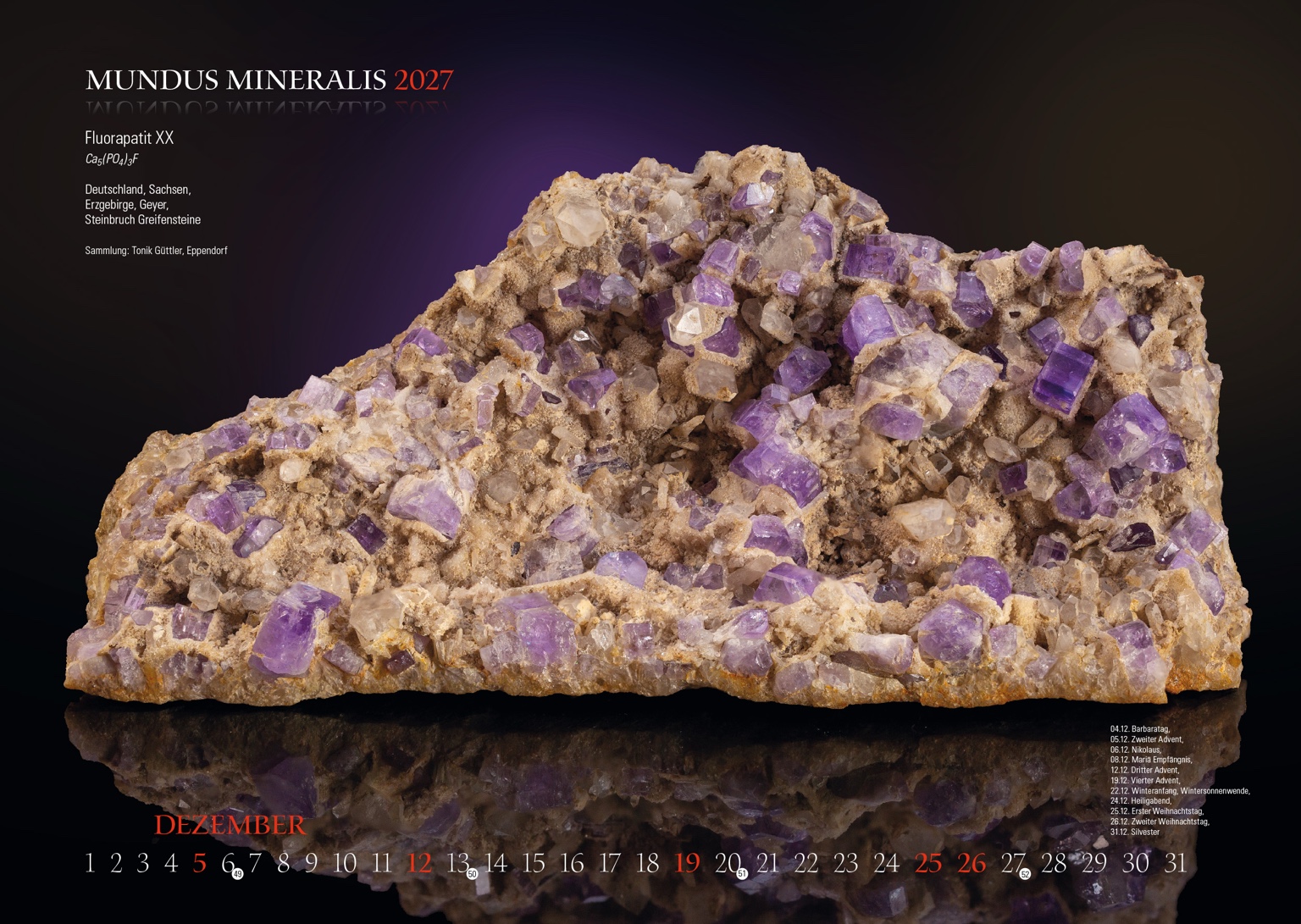
December 2027
Fluorapatite from the Greifensteine
Violet fluorapatite crystals are scattered across a pale beige matrix. Some appear strongly coloured, others almost transparent. Their clearly defined faces stand out against the finely textured background, providing a colourful conclusion to the monthly sequence shown here.
Locality: Greifensteine quarry, Geyer, Ore Mountains, Saxony, Germany. Collection: Tonik Güttler, Eppendorf.
2026 EDITION
Mundus Mineralis 2026
The 2026 edition is documented here with its cover and all twelve monthly pages. Minerals from the Ore Mountains appear alongside specimens from Romania, China, India and Russia.
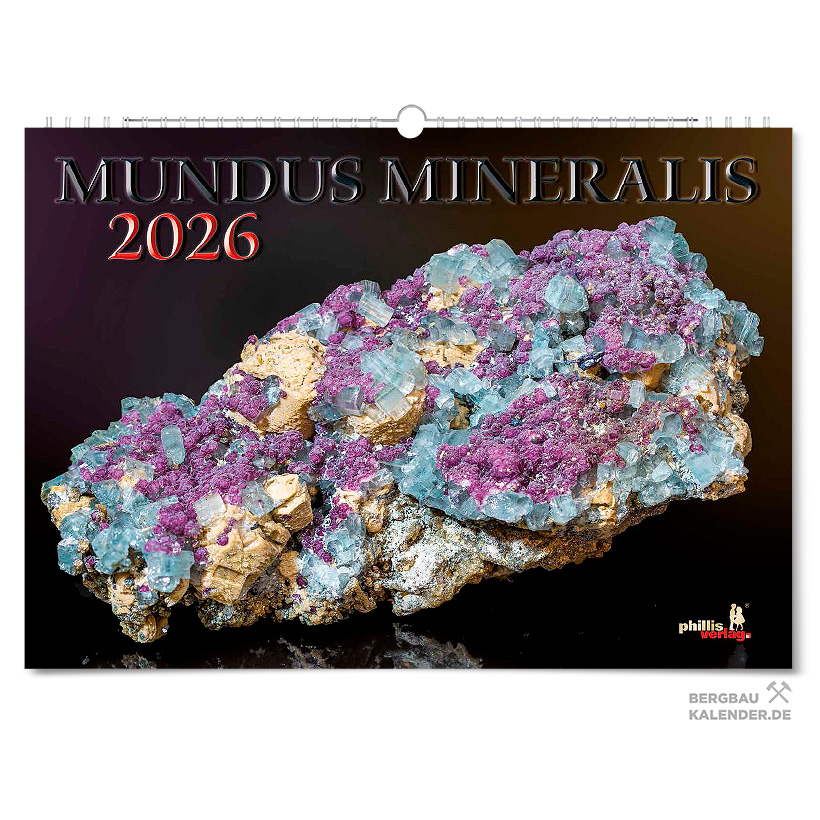
Cover 2026
Crystal colours in blue and violet
Pale blue translucent crystals and vivid violet areas define the cover image. The dark background brings out their different shapes and surfaces. The cover does not specify a mineral name or locality.
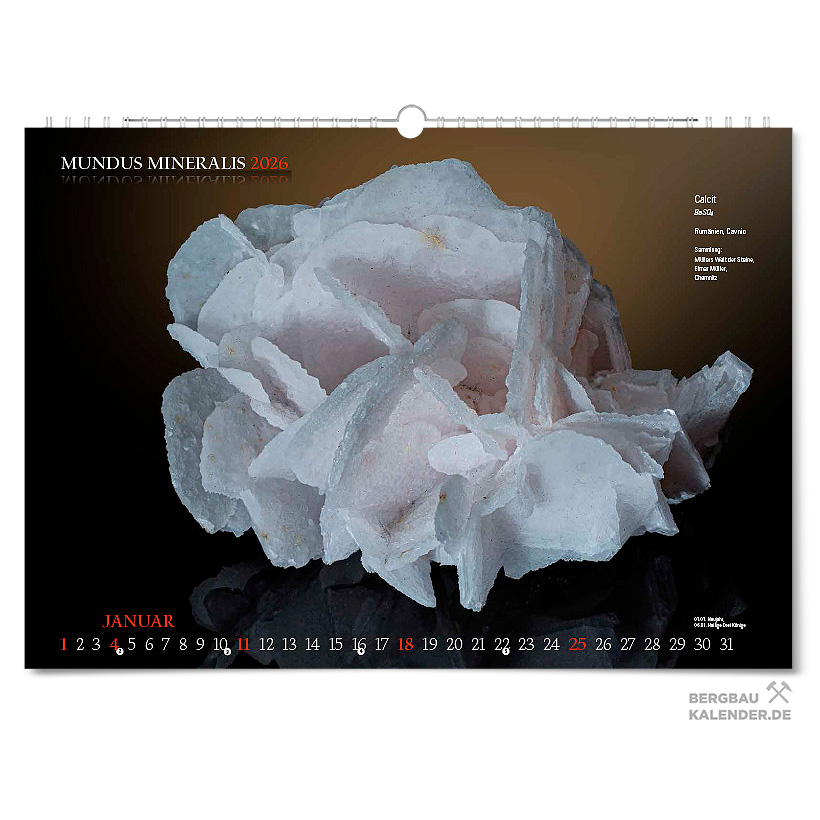
January 2026
Calcite from Cavnic
Pale, plate-like crystals overlap to form a large rosette-like group. Delicate pink and bluish shading emphasises their edges.
Locality: Cavnic, Romania. Collection: Müllers Welt der Steine, Elmar Müller, Chemnitz.
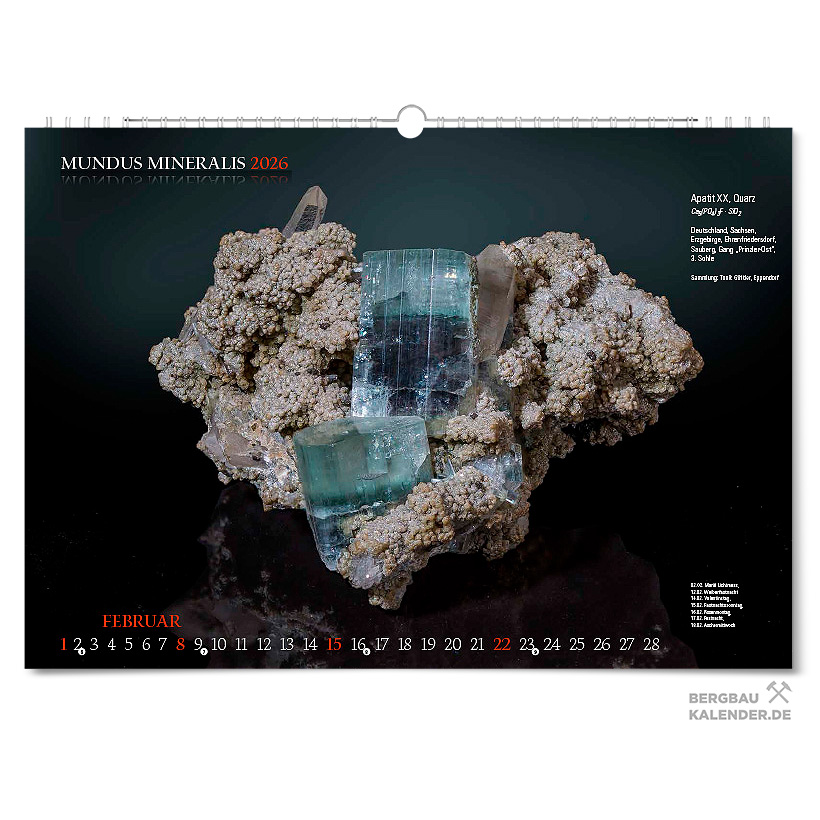
February 2026
Apatite and quartz
Blue-green prismatic apatite crystals stand between quartz and a finely crystalline matrix. The lighting reveals their translucent faces and striations.
Locality: Sauberg, Ehrenfriedersdorf, Ore Mountains, Saxony, Germany. Collection: Tonik Güttler, Eppendorf.
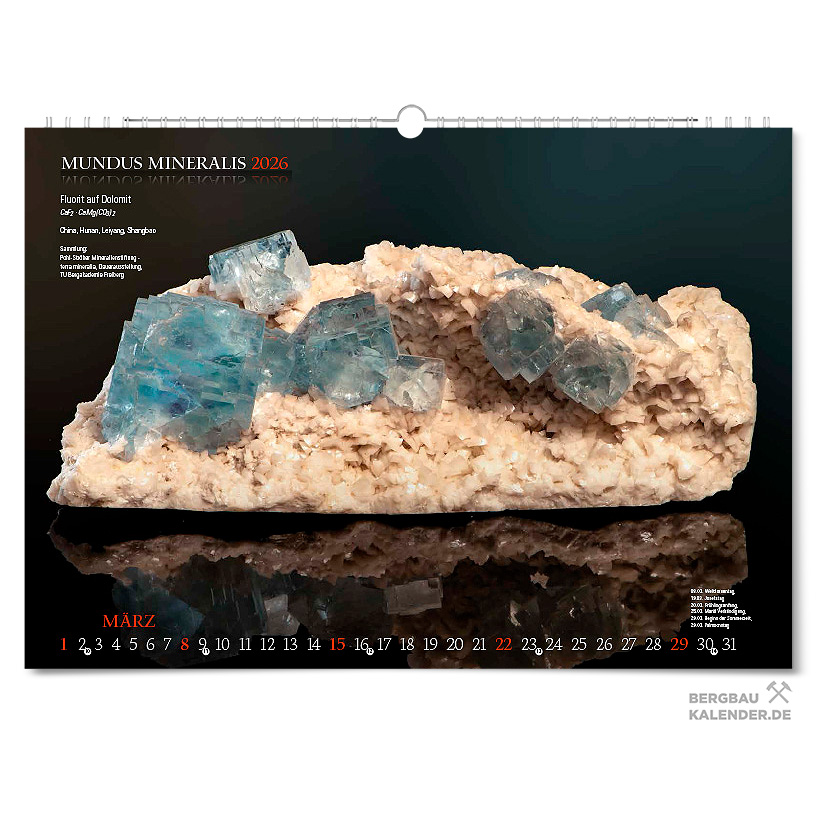
March 2026
Fluorite on dolomite
Blue to blue-green fluorite cubes sit on a pale dolomite base. Their large, smooth faces contrast with the finely textured background.
Locality: Shangbao, Leiyang, Hunan, China. Collection: Pohl-Ströher Mineralienstiftung – terra mineralia, TU Bergakademie Freiberg.

April 2026
Fluorite on quartz
Honey-yellow fluorite crystals glow between pale quartz crystals. The dark background and the reflection beneath the specimen intensify the colour contrast.
Locality: Sauberg, Ehrenfriedersdorf, Ore Mountains, Saxony, Germany. Collection: Tonik Güttler, Eppendorf.
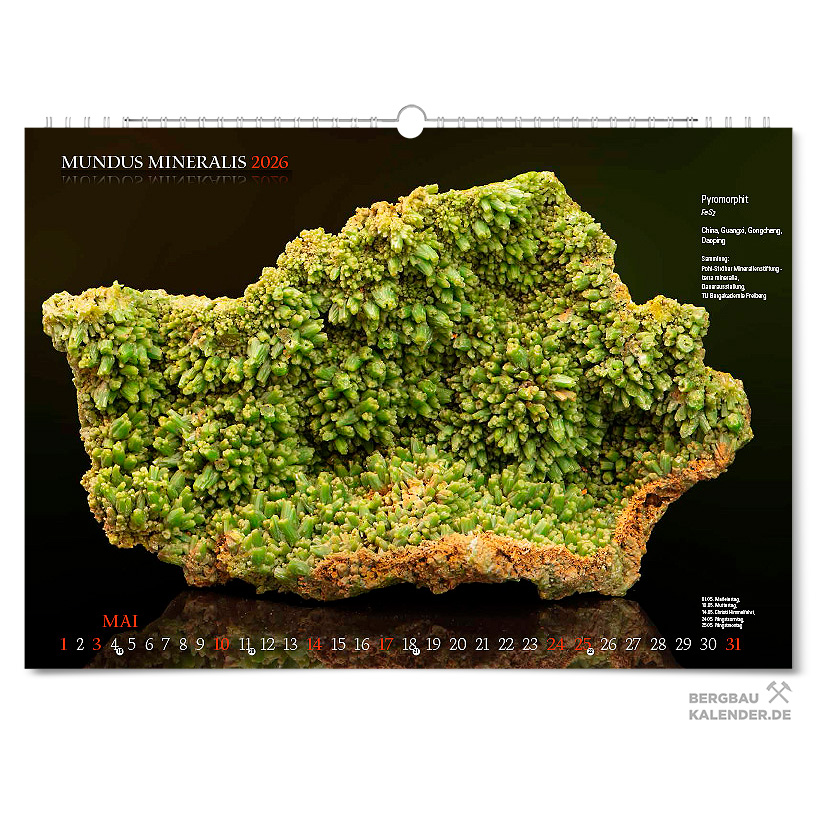
May 2026
Pyromorphite from China
Densely packed yellow-green crystals cover the specimen. Their different growth directions and numerous small faces give the surface a lively texture.
Locality: Daoping, Gongcheng, Guangxi, China. Collection: Pohl-Ströher Mineralienstiftung – terra mineralia, TU Bergakademie Freiberg.
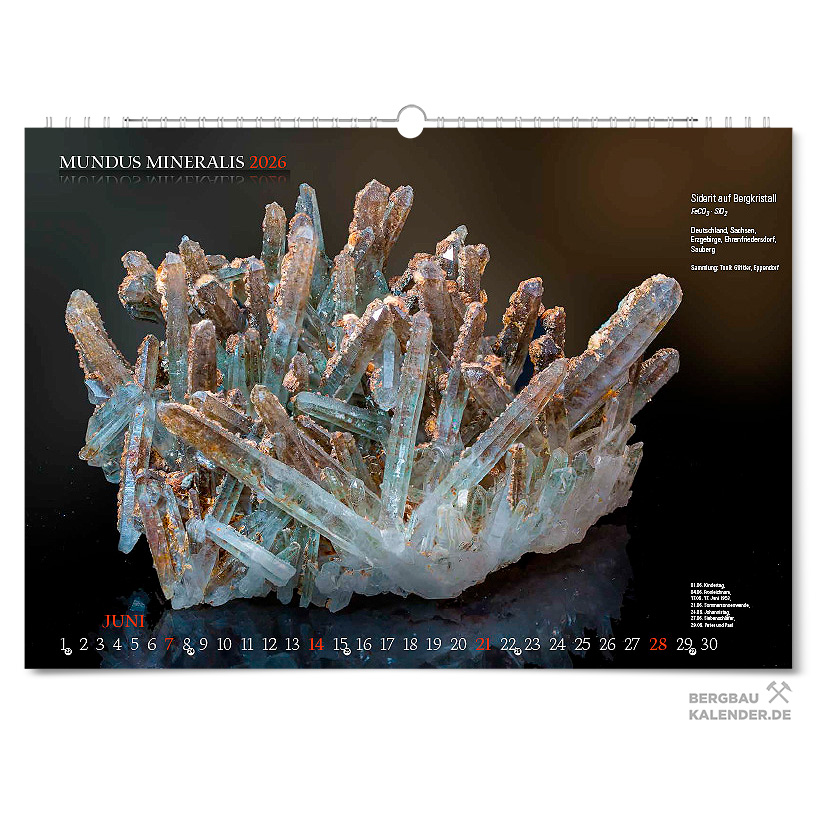
June 2026
Siderite on rock crystal
Slender rock crystals project in different directions. Brown siderite coatings stand out against the pale, translucent crystal bodies.
Locality: Sauberg, Ehrenfriedersdorf, Ore Mountains, Saxony, Germany. Collection: Tonik Güttler, Eppendorf.

July 2026
Cavansite, stilbite and heulandite
Vivid blue, rounded cavansite groups sit on a pale, slightly peach-coloured crystalline base. The photograph highlights the strong contrast between the blue crystal clusters and their surroundings.
Locality: Wagholi, Pune, Maharashtra, India. Collection: Pohl-Ströher Mineralienstiftung – terra mineralia, TU Bergakademie Freiberg.

August 2026
Fluorite from the Sauberg
Orange to pink fluorite crystals emerge from a dark green matrix. Smooth crystal faces, internal colour variations and reflected light define the image.
Locality: Sauberg, Ehrenfriedersdorf, Ore Mountains, Saxony, Germany. Collection: Tonik Güttler, Eppendorf.

September 2026
Apophyllite, stilbite, calcite and quartz
An intensely green crystal group forms the centre of the pale specimen. White and pink areas frame it, making its pointed crystals particularly distinct.
Locality: Jalgaon, Maharashtra, India. Collection: Pohl-Ströher Mineralienstiftung – terra mineralia, TU Bergakademie Freiberg.
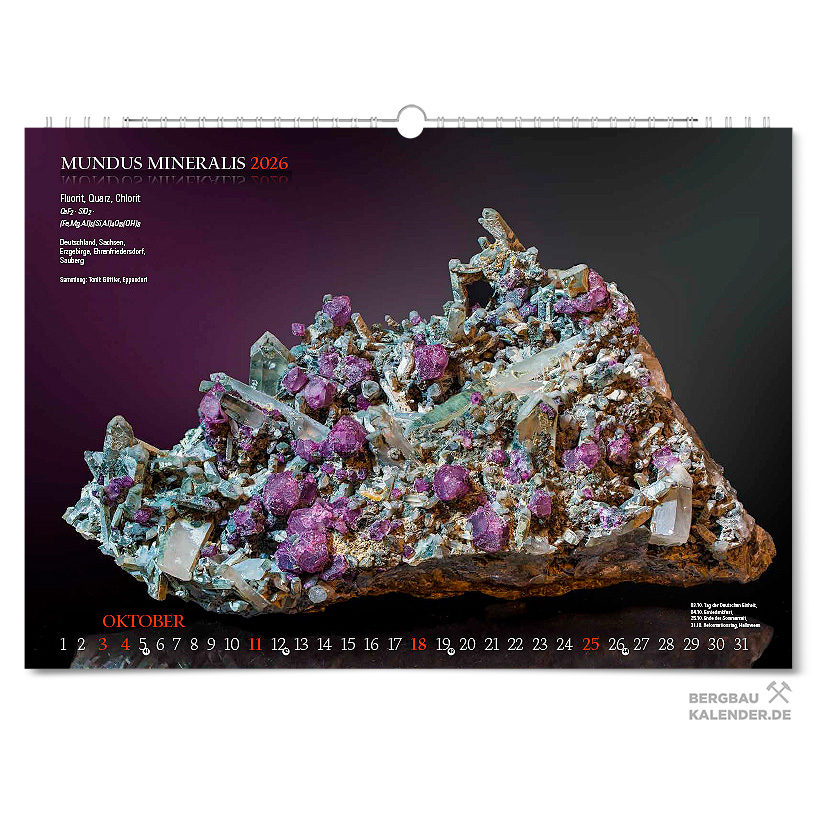
October 2026
Fluorite, quartz and chlorite
Violet fluorite crystals are scattered between elongated quartz crystals and greenish areas. The combination of different crystal forms makes this specimen especially varied.
Locality: Sauberg, Ehrenfriedersdorf, Ore Mountains, Saxony, Germany. Collection: Tonik Güttler, Eppendorf.
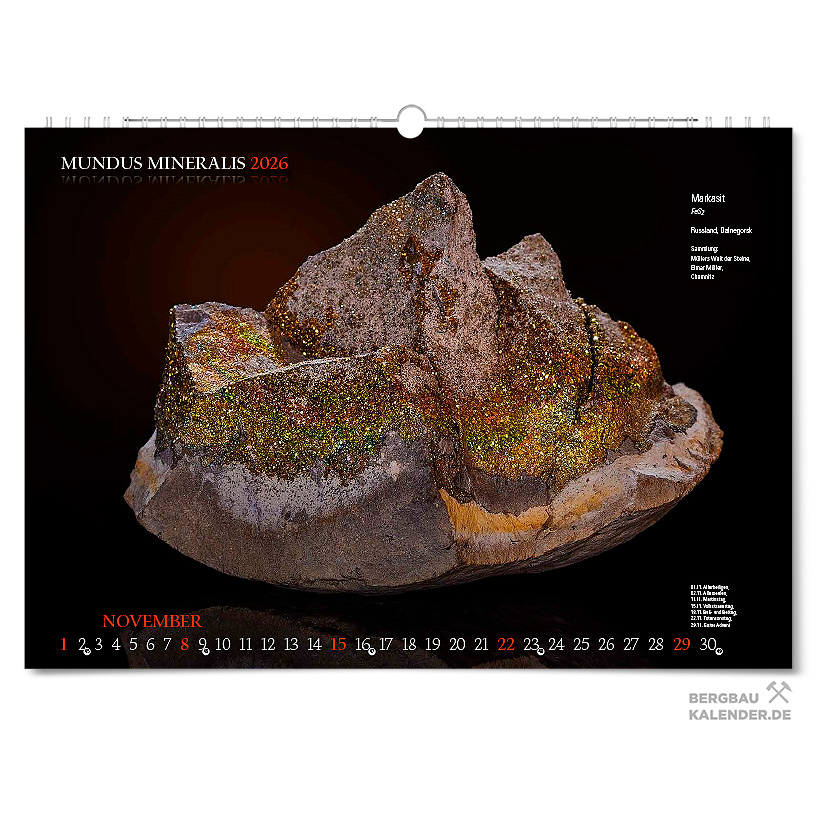
November 2026
Marcasite from Dalnegorsk
An angular crystal group displays a finely textured metallic lustre. Golden, bronze and occasionally iridescent reflections enliven its dark surfaces.
Locality: Dalnegorsk, Russia. Collection: Müllers Welt der Steine, Elmar Müller, Chemnitz.

December 2026
Stephanite, native arsenic and proustite
Dark crystals with a metallic lustre sit on a grey, finely textured specimen. The photograph highlights their sharp edges and reflective faces.
Locality: Sauberg, Ehrenfriedersdorf, Ore Mountains, Saxony, Germany. Collection: Tonik Güttler, Eppendorf.
2025 EDITION
Mundus Mineralis 2025
From the image archive, we present the cover and the monthly pages for February, March, June, July, November and December. Further pages can be added to complete this edition.
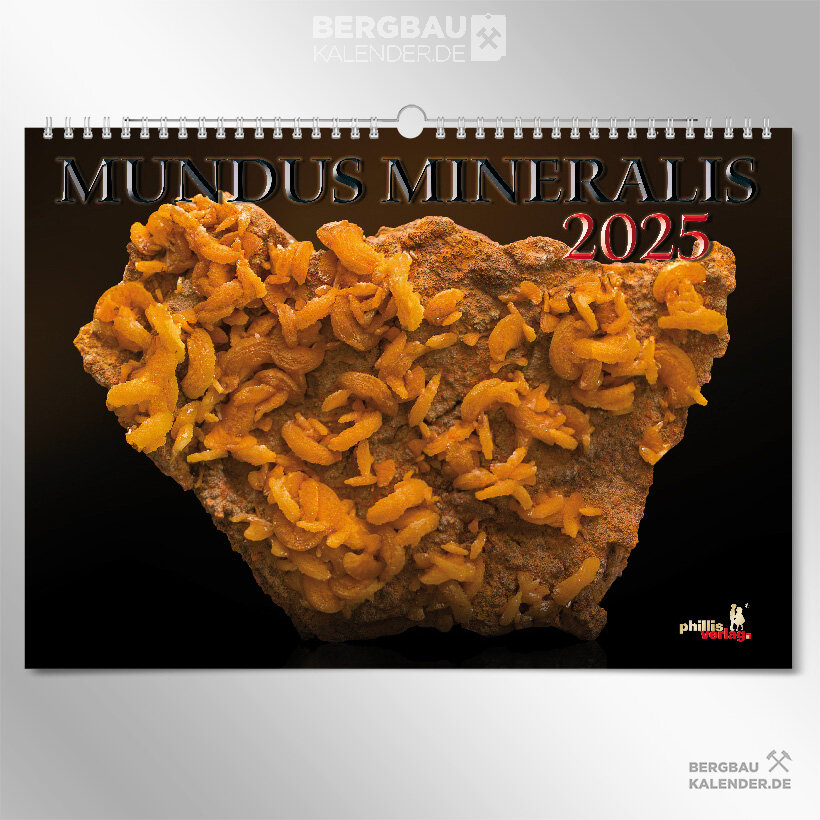
Cover 2025
Golden-yellow forms against a dark background
The cover shows numerous golden-yellow to orange curved and elongated forms on a brown matrix. The mineral name and locality are not given on the cover.
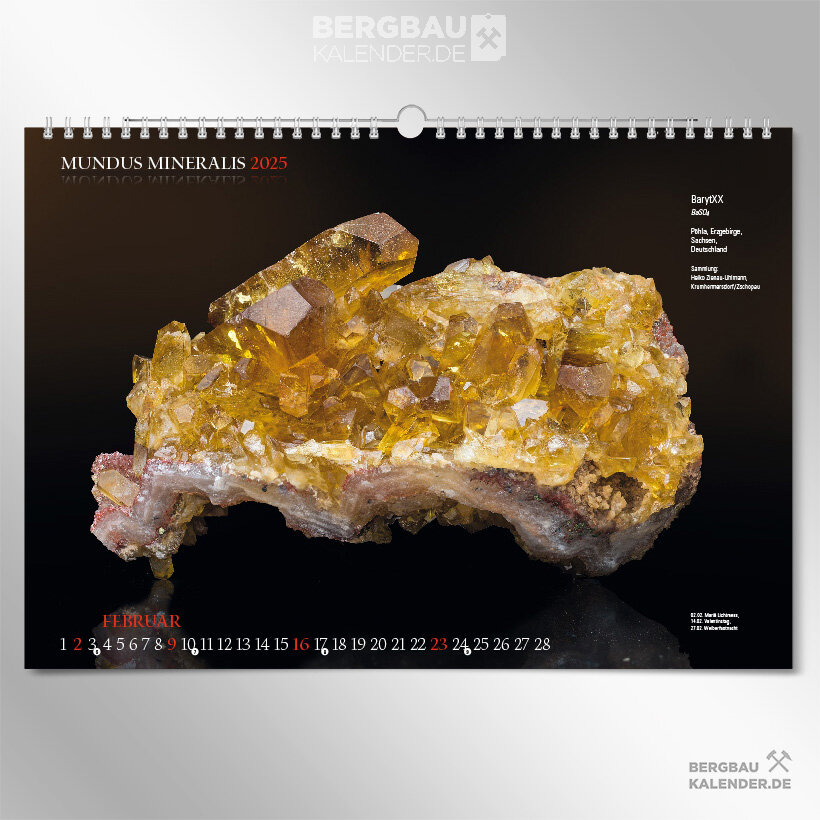
February 2025
Baryte from Pöhla
Translucent honey-yellow baryte crystals grow on a pale to pink base. Clearly defined faces and reflected light give the group depth.
Locality: Pöhla, Ore Mountains, Saxony, Germany.

March 2025
Stibiconite pseudomorph after stibnite
Long golden-brown crystal forms project in clusters. Lengthwise striations and the different crystal orientations define the image.
Locality: Xikuangshan (Lengshuijiang), Hunan, China. Collection: Pohl-Ströher Mineralienstiftung – terra mineralia, TU Bergakademie Freiberg.
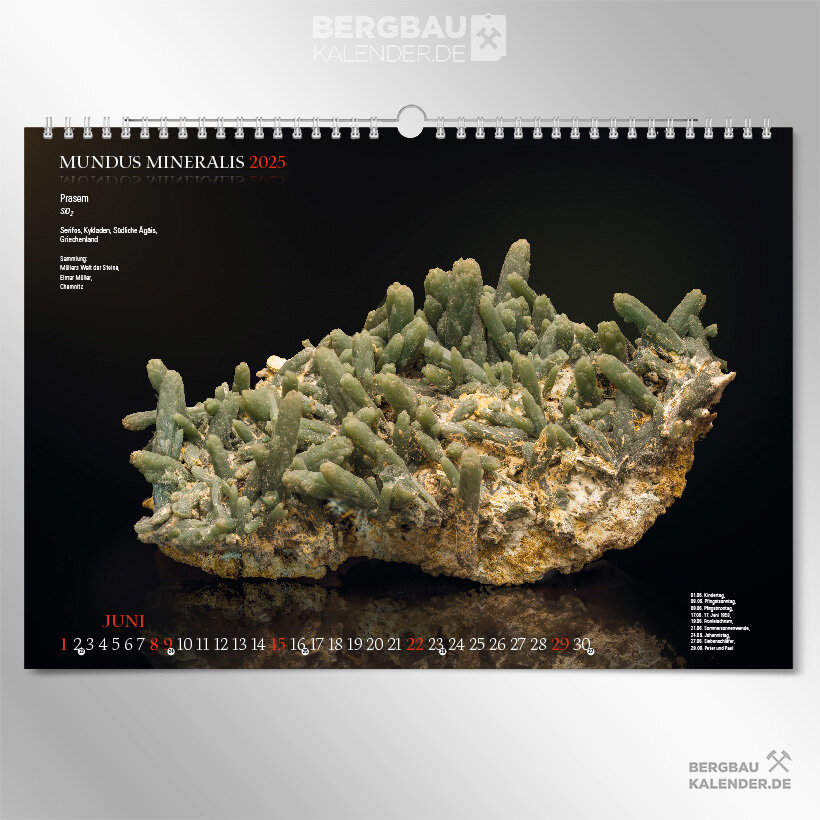
June 2025
Prase from Greece
Numerous green elongated crystals cover the pale matrix. Their differently inclined tips create a densely populated, irregular surface.
Locality: Serifos, Cyclades, South Aegean, Greece. Collection: Müllers Welt der Steine, Elmar Müller, Chemnitz.
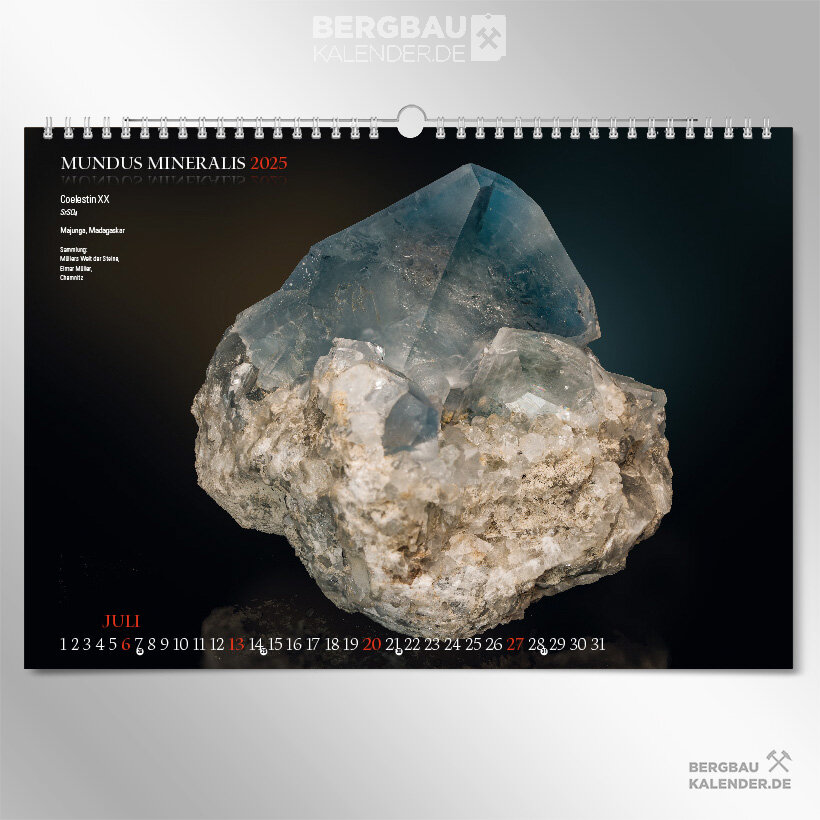
July 2025
Celestine from Madagascar
A large translucent blue crystal dominates the specimen. Smaller, almost colourless crystals surround its base and provide a pale contrast.
Locality: Majunga, Madagascar. Collection: Müllers Welt der Steine, Elmar Müller, Chemnitz.
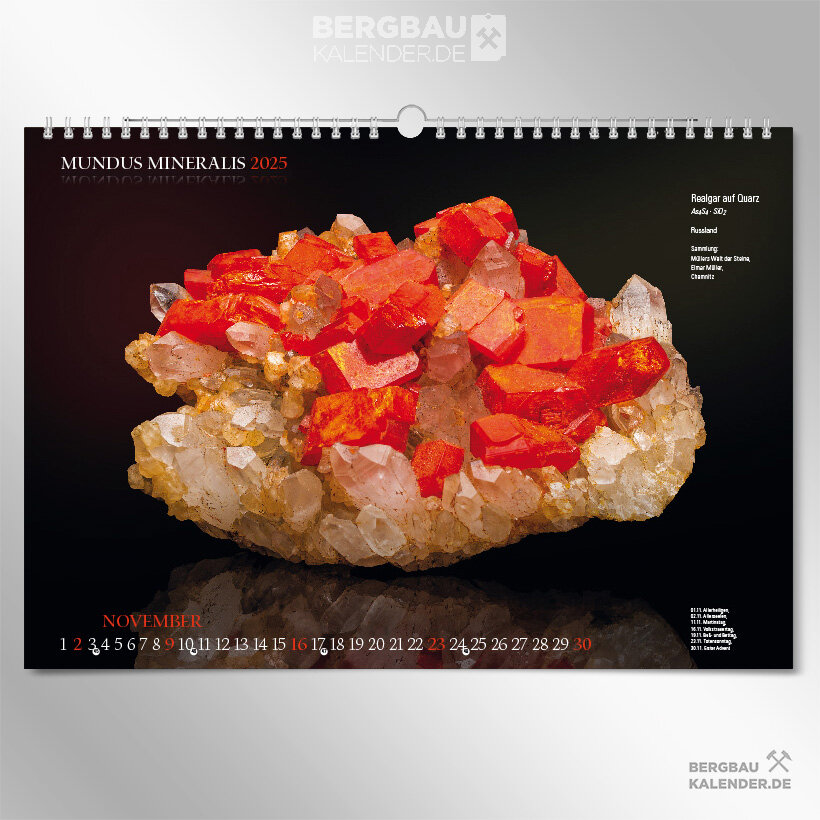
November 2025
Realgar on quartz
Bright red and orange realgar crystals sit between pale quartz crystals. Their smooth faces and warm colours are the focus of the photograph.
Locality: Russia. Collection: Müllers Welt der Steine, Elmar Müller, Chemnitz.
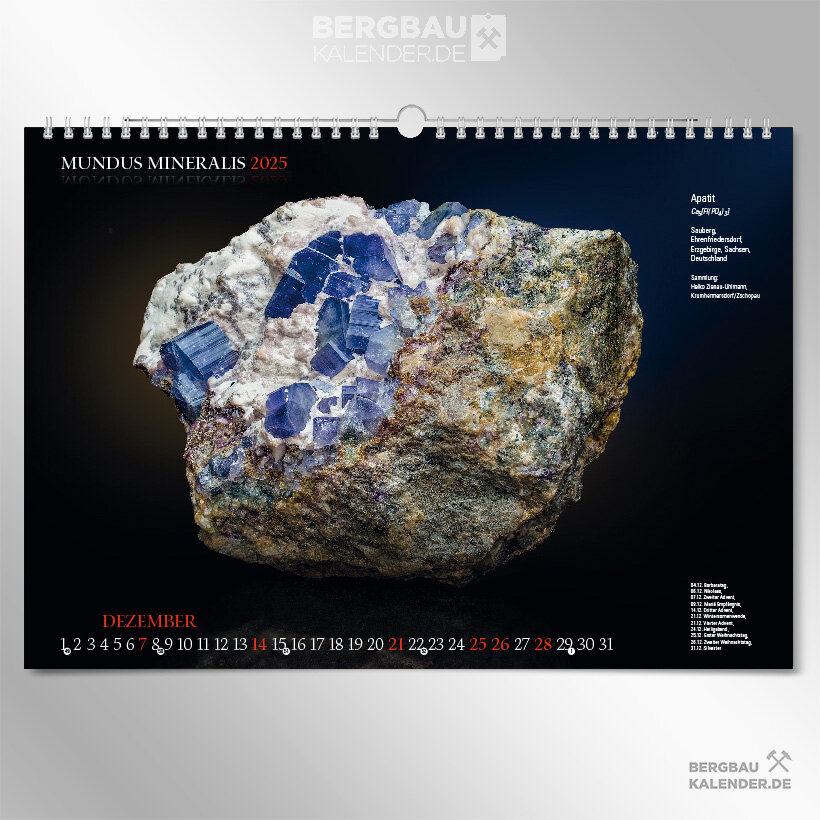
December 2025
Apatite from Ehrenfriedersdorf
Deep blue apatite crystals sit in a white and greenish-brown matrix. The close-up reveals clear crystal edges and fine striations.
Locality: Sauberg, Ehrenfriedersdorf, Ore Mountains, Saxony, Germany.
An archive that grows with every edition
This page is developing into a continuous overview of the Mundus Mineralis calendars. New editions take their place at the beginning of the sequence. Earlier editions are added below in descending order, each with its calendar pages and information about minerals, localities and collections. There are currently 28 images from the 2027, 2026 and 2025 editions.
Frequently asked questions about Mundus Mineralis
When did the calendar series begin?
Its roots lie in the Terra Mineralia calendars from 2013 onwards. The title Mundus Mineralis is documented for the 2015 edition.
What makes the photographs special?
The large-format presentation highlights colours, crystal faces and fine structures. On the monthly pages shown here, mineral names, localities and collection details complement the photographs.
Are all editions and monthly pages already available?
The archive is being built gradually. It currently contains eight images from 2027 (the cover and June to December), the complete 2026 edition with 13 images, and seven images from 2025 (the cover and six monthly pages). Missing pages and further earlier editions will be added.
Sources and image credits: Calendar images: Mundus Mineralis 2025, 2026 and 2027, PhillisVerlag; existing Bergbaukalender.de image archive. Mineral names, localities and collections follow the captions printed on the monthly pages shown. History and features are based on the publisher’s information about the 2015 edition and the PhillisVerlag calendar overview. The image descriptions explain visible features of the supplied photographs. The original calendar images retain their printed German text.


