
CALENDAR ARCHIVE / 2018
Mining Calendar 2018 – Saxon Mining, Anniversary Edition
The 25th edition looks back on a quarter-century of the Saxon Mining Calendar. Each month has two image pages, covering underground workings, mining machinery, water management, historical documents, art and mineralogy.
This archive contains all 28 original pages: cover, foreword sheet, 24 monthly image pages and two notes pages. The complete introduction to the history of the calendar series is also available as readable text in English translation.
25th edition · 28 original pages · Two image pages per month · Photographs and text: Jens Kugler
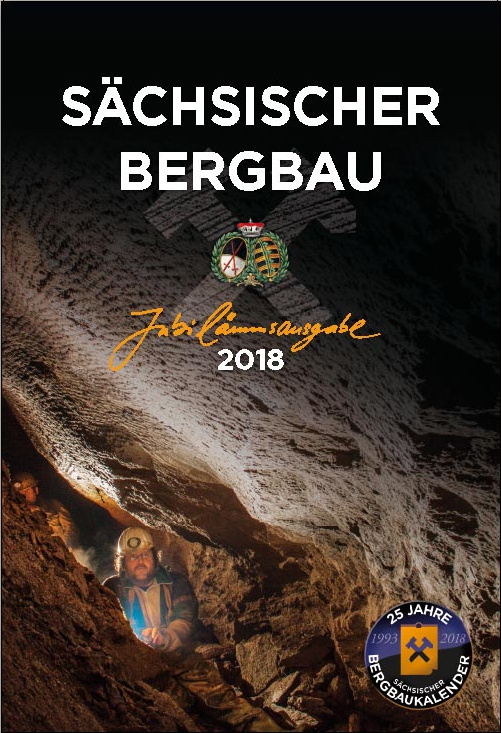
COVER · 2018
Saxon Mining – Anniversary Edition
The cover shows old stopes at Himmelfahrt Fundgrube in Freiberg reached by the Thurmhofer Hilfsstolln. Photograph: Jens Kugler, 2012. The edition commemorates twenty-five years of the Saxon Mining Calendar.

FOREWORD · 2018
25 Years of the Saxon Mining Calendar
The foreword sheet assembles the calendar covers from 1994 to 2018 around an account of the series’ origins and development. The complete introduction follows in readable English translation.
English translation of the original 2018 anniversary introduction. References to the present day refer to its year of publication.
Saxon Mining Calendar
Twenty-five years ago, what is now the Media Centre of TU Bergakademie Freiberg and the Druckspecht company in Langenstriegis put into practice the idea of demonstrating the capabilities of the newly established printing company with a calendar printed on different types of paper. Mining in Saxony was chosen as its subject. The unexpectedly enthusiastic response and recognition received by the first calendar led to the project’s continuation. The calendars of the early years still revealed a search for their own identity. With the themed calendar “Bergstädte”, attention was focused on a single subject for the first time. A concept using one main image with small supplementary illustrations was adopted, and proved successful in subsequent years, as did the portrait format.
As its title suggests, the calendar was geographically confined to Saxony, with a consistent focus on the historically significant mining industry of the Erzgebirge. To distinguish it from other calendars that took up the same subject over time, the name “Original Saxon Mining Calendar” was adopted. For years, the calendar has been a sought-after collectible for individuals as well as libraries and archives. This is due to the outstanding photographs, most of them previously unpublished, as much as to the appealing layout and excellent printing. The calendar remains a popular gift from associations to their members and partners, and from companies to their employees and customers.
Twenty-five years of the Mining Calendar also means twenty-five years of profound changes in photography and image processing, prepress work and printing techniques – the transition from analogue to digital. With this anniversary calendar, we would above all like to thank our loyal customers. Its impressive photographs look back on and reconnect with the individual themes of the past twenty-five years, from raw-material extraction to processing, and from art to science.

JANUARY 1 · 2018
Reinsberg – adit portals
The lower portal of the water-supply channel at Emanuel Erbstolln in Reinsberg opens the monthly series.

JANUARY 2 · 2018
Obergruna – mine support
Masonry and roof protection near the portal of the Tiefer Hilfe Gottes Stolln in Obergruna.

FEBRUARY 1 · 2018
Brand-Erbisdorf – inscriptions
A mining-boundary tablet on the Donath Spat vein between Gelobt Land Fundgrube and St. Donath Fundgrube near Brand-Erbisdorf.
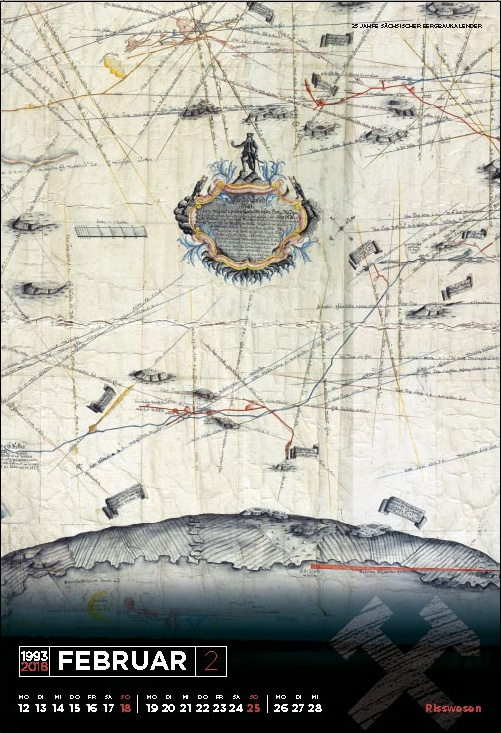
FEBRUARY 2 · 2018
Glashütte – mine plans
Detail of a mining-district plan of Glashütte by mine surveyor Johann Carl Goldberg. The original credit refers to the Freiberg Mining Archive and its state mining plans.

MARCH 1 · 2018
Hohentanne – stopes
A small stope in the Tiefer Friedrich Stolln at Gottvertrauender Daniel Erbstolln near Hohentanne.
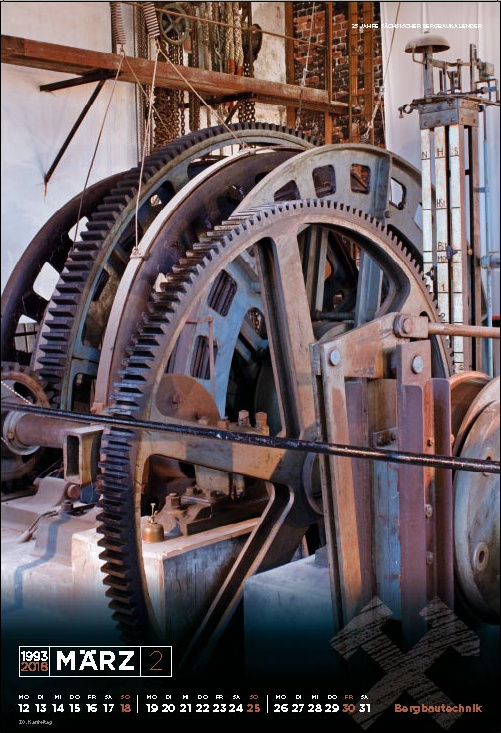
MARCH 2 · 2018
Zug near Freiberg – mining machinery
The winding engine of Drei-Brüder-Schacht at Herzog August Fundgrube near Zug.

APRIL 1 · 2018
Frohnau – historical documents
A historical mining-share certificate from Frohnau. The page illustrates the documentary heritage of mining; the original credit names the L. Riedel collection and reproduction.
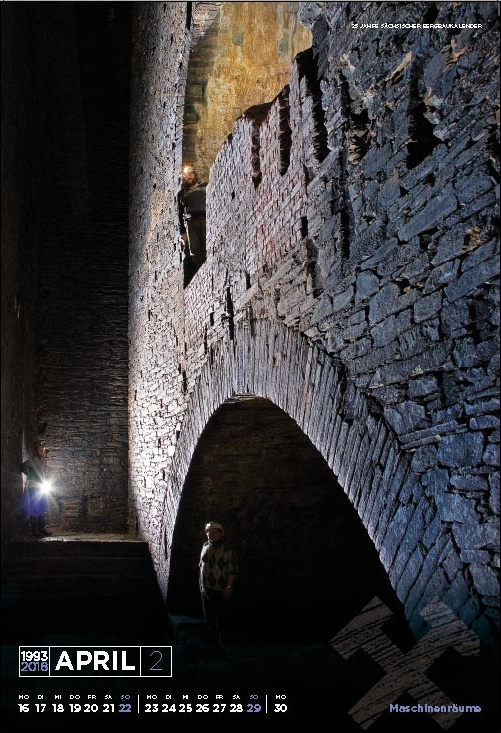
APRIL 2 · 2018
Schneeberg-Neustädtel – machinery chambers
Masonry in the reversible-waterwheel chamber of Weißer Hirsch Fundgrube in Schneeberg-Neustädtel.

MAY 1 · 2018
Niederpfannenstiel – education and science
A collection of cobalt ores associated with the Niederpfannenstiel blue-pigment works near Aue. Collection credit: TU Bergakademie Freiberg.

MAY 2 · 2018
Berggießhübel – shafts
Masonry lining in an access shaft of the Tiefer Zwiesler Erbstolln near Berggießhübel.

JUNE 1 · 2018
Hohe Birke Kunstgraben – water channels
The Hohe Birke Kunstgraben, part of Freiberg’s mining-water management system. The covered channel and its course illustrate the supply of water to mining installations.
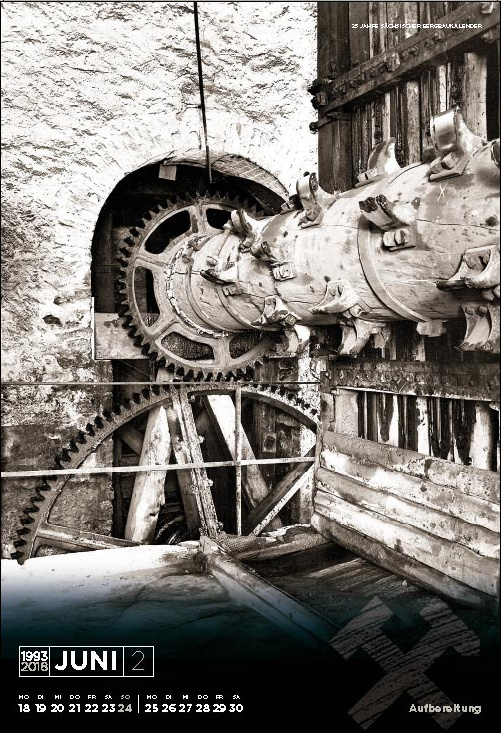
JUNE 2 · 2018
Kleinvoigtsberg – ore processing
A historical photograph of the wet stamping mill used for ore processing at Alte Hoffnung Gottes Erbstolln in Kleinvoigtsberg. The original credit names Walter Möbius as photographer.
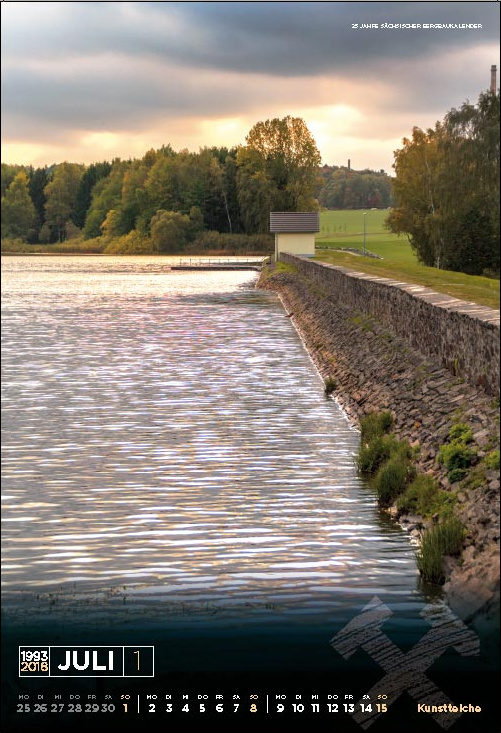
JULY 1 · 2018
Berthelsdorf – mining reservoirs
The dam and outlet-control house of the Hüttenteich near Berthelsdorf, part of Freiberg’s mining-water management system.
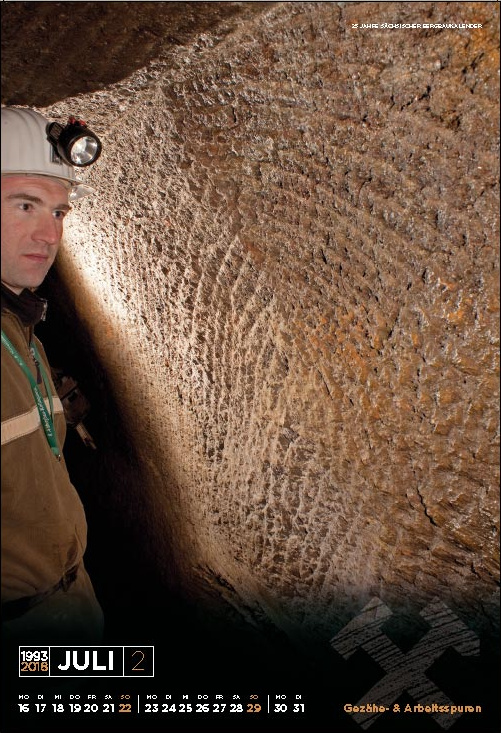
JULY 2 · 2018
Frohnau – tools and working traces
Tool marks and working traces on the Spatflügel branch of the Oberer Markus Röhling Stolln near Frohnau.

AUGUST 1 · 2018
Großschirma – surface buildings
The mining lodge of Churprinz Friedrich August Erbstolln in Großschirma.

AUGUST 2 · 2018
Rothenfurth – coins and medals
Electrotype of a mining-yield medal associated with St. Anna samt Altväter Fundgrube near Rothenfurth, Großschirma. The reverse is shown. Original collection and photograph credit: Jens Kugler.

SEPTEMBER 1 · 2018
Halsbrücke – shaft installations
The water-powered winding house above the pumping and winding shaft at Hoffnung Schacht, Himmelfahrt Fundgrube/Oberes Neues Geschrei near Halsbrücke.
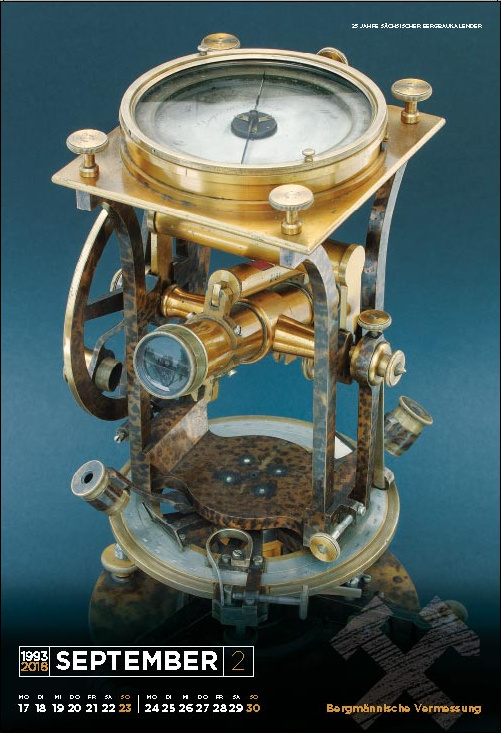
SEPTEMBER 2 · 2018
Freiberg – mine surveying
A historical theodolite from the collection of the Institute of Mine Surveying and Geodesy at TU Bergakademie Freiberg.
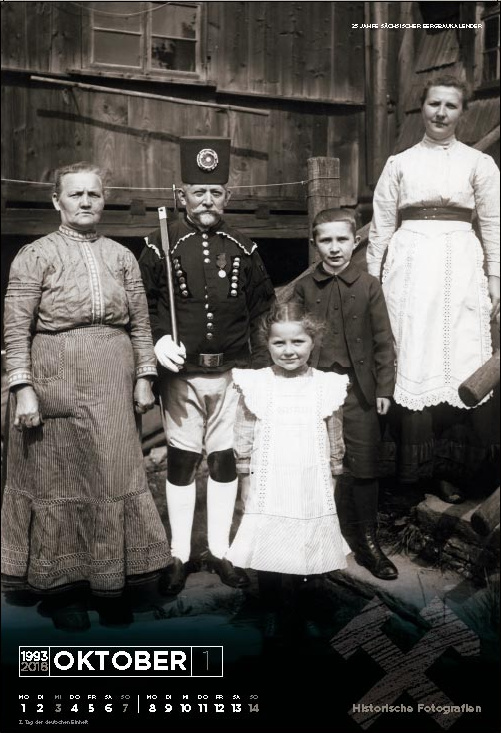
OCTOBER 1 · 2018
Schneeberg-Neustädtel – historical photographs
A historical photograph of a stamping-mill foreman with his family. The original credit names the Museum of Mining Folk Art in Schneeberg.
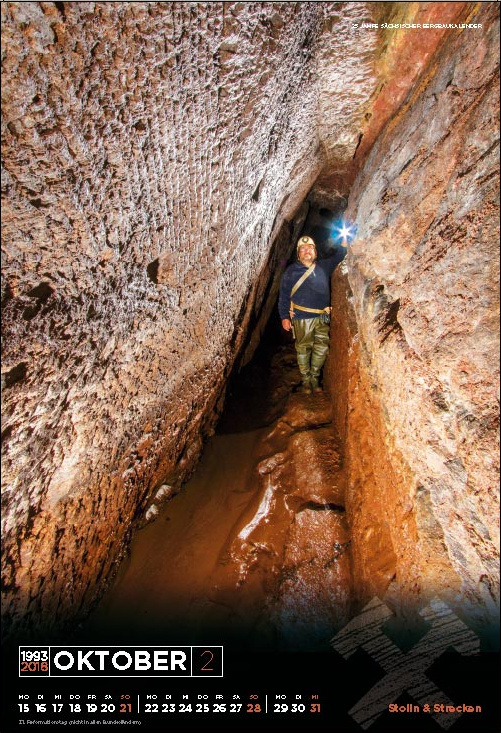
OCTOBER 2 · 2018
Großolbersdorf – adits and levels
An adit cross-section and sixteenth-century working traces in the Gideon Tiefer Erbstolln near Großolbersdorf.
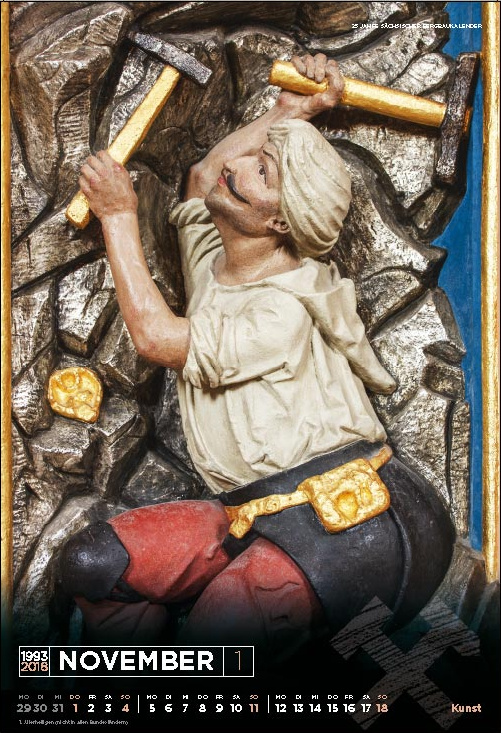
NOVEMBER 1 · 2018
Annaberg-Buchholz – art
A detail of the miners’ pulpit by sculptor Franz Maidburg in St. Anne’s Church in Annaberg-Buchholz.

NOVEMBER 2 · 2018
Kleinvoigtsberg – geology and mineralogy
A vein specimen with cockade ore from Alte Hoffnung Gottes Erbstolln in Kleinvoigtsberg. Collection credit: the mineral-deposit collection of TU Bergakademie Freiberg.

DECEMBER 1 · 2018
Obergruna – water tunnels
A water tunnel through the spoil heap of Steyer Schacht at Bergmannshoffnung Fundgrube near Obergruna.

DECEMBER 2 · 2018
Pobershau – preserving mining traditions
Miners at the twelfth Bergmanns-, Hütten- und Knappentag gathering in Pobershau/Marienberg.
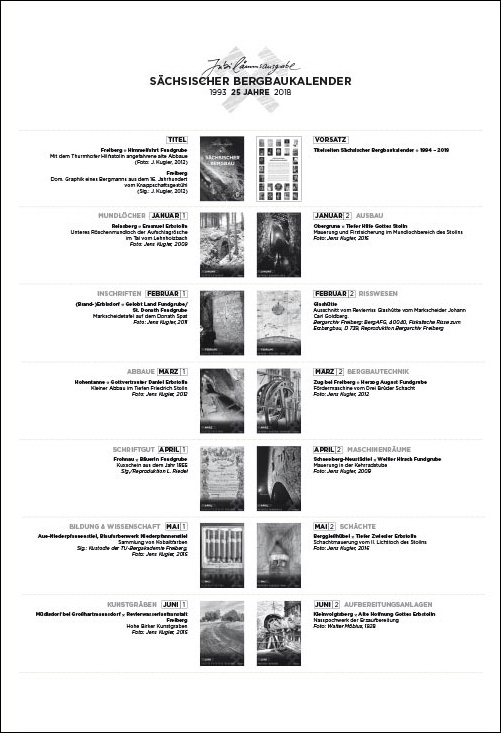
NOTES 1 · 2018
Cover to June – image credits
The first notes page identifies the locations, subjects and image credits for the cover, foreword and both image pages of January to June.
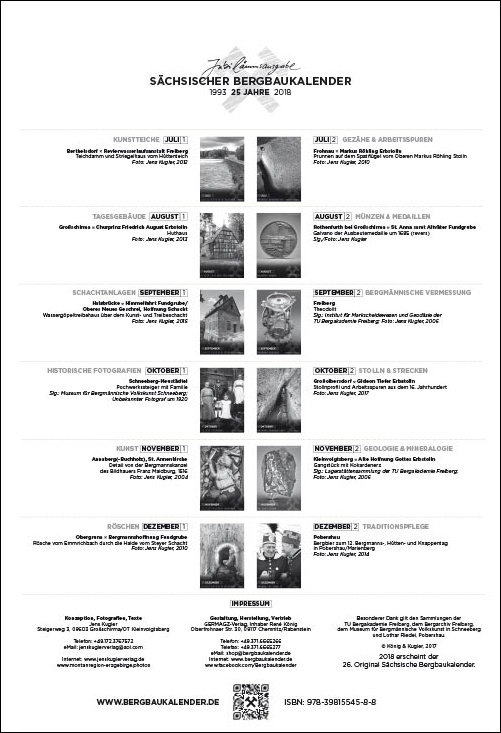
NOTES 2 · 2018
July to December – image credits and imprint
The second notes page identifies the locations and image credits for July to December, followed by the original imprint, acknowledgements and ISBN.


