
CALENDAR ARCHIVE / 2019
Mining Calendar 2019 – Saxon Mining
The 26th edition explores Saxony’s mining history. Two image pages per month present mining machinery and workings, water management, historical documents, art and mineralogy.
All 28 original pages are included: cover, foreword sheet, 24 monthly image pages and two notes pages. The complete introduction is also available as readable text in English translation.
26th edition · 28 original pages · Two image pages per month · Photographs and text: Jens Kugler

COVER · 2019
Saxon Mining
Fortuna Fundgrube in Breitenbrunn: workings in the Fortuna mine. Photograph: Jens Kugler.
FOREWORD · 2019
Saxon Mining Calendar 2019
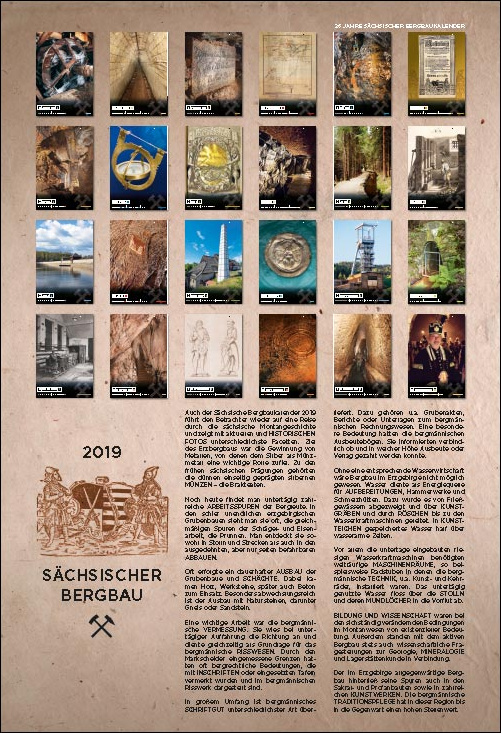
The foreword sheet presents all 24 monthly images and the introduction, followed here by a readable English translation.
English translation of the original 2019 introduction. References to the present day refer to its year of publication.
Saxon Mining
The Saxon Mining Calendar 2019 once again takes the viewer on a journey through Saxony’s mining history, presenting its many facets through contemporary and HISTORICAL PHOTOGRAPHS. Ore mining aimed to extract metals, among which silver played an important role as a metal for coinage. Early Saxon issues included thin silver COINS struck on one side only: bracteates.
Numerous TRACES OF THE MINERS’ WORK can still be found underground. The seemingly endless mine workings of the Erzgebirge often reveal the regular marks left by hammer-and-chisel work, known as Prunen. They can be discovered in adits and levels as well as in extensive STOPES, which are only rarely accessible.
Mine workings and SHAFTS were often provided with permanent SUPPORT. Timber and dressed stone were used, followed later by concrete. Natural-stone support is particularly varied, including gneiss and sandstone.
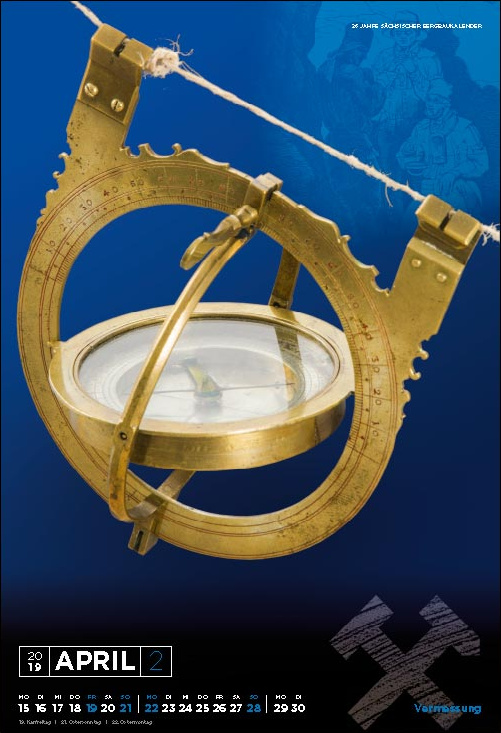
Mine SURVEYING was an important task. It provided direction when driving workings underground and also formed the basis of mining PLANS. Boundaries measured by the mine surveyor often had significance under mining law. They were marked with INSCRIPTIONS or inserted tablets and shown on mine plans.
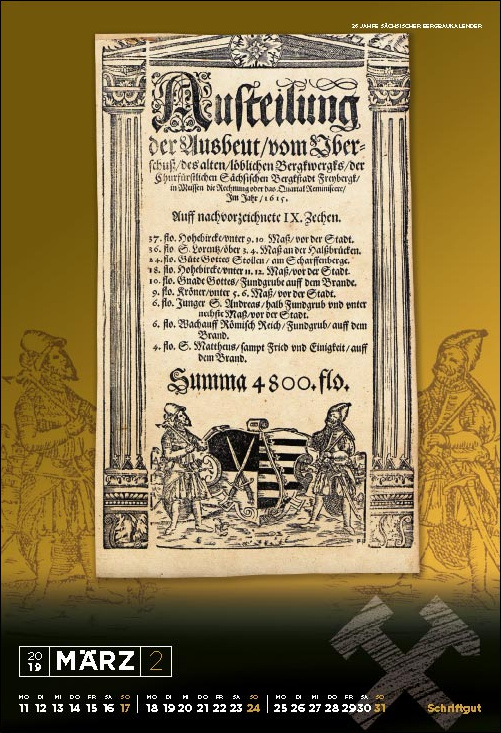
A wide range of mining DOCUMENTS has survived, including mine files, reports and mining accounts. Mining distribution statements were particularly important. They provided binding information on whether, and in what amount, a dividend or an advance could be paid.
Mining in the Erzgebirge would not have been possible without a suitable water-management system. Water supplied energy for ORE-PROCESSING PLANTS, hammer mills and smelting works. It was diverted from rivers and streams and conveyed through ARTIFICIAL CHANNELS and WATER TUNNELS to the water-powered machinery. Water stored in MINING RESERVOIRS helped during periods of low water.
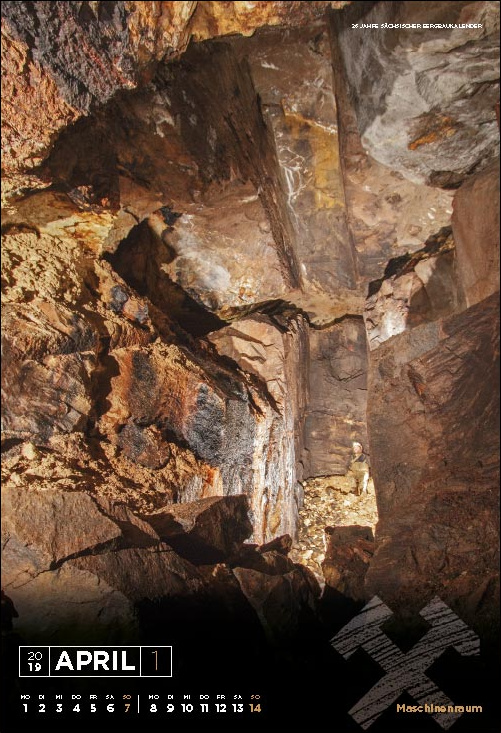
The enormous water-powered machines installed underground required spacious MACHINERY CHAMBERS, such as wheel chambers containing mining MACHINERY, including pumping wheels and reversible waterwheels. Water used underground flowed through ADITS and their PORTALS into the receiving watercourses.
EDUCATION AND SCIENCE were of fundamental importance as conditions in the mining industry continued to develop. Active mining was also always linked to scientific questions in geology, MINERALOGY and the study of mineral deposits.
The mining industry, present throughout the Erzgebirge, also left its mark on religious and secular buildings and on numerous WORKS OF ART. Preserving MINING TRADITIONS remains highly valued in this region.

JANUARY 1 · 2019
Freiberg – machinery
Freibergsdorf hammer mill: the mill’s drive shaft. Photograph: Jens Kugler.

JANUARY 2 · 2019
Burgk near Freital – mine support
Neuhoffnungschachter Tagesstrecke: elliptical sandstone lining. Photograph: Jens Kugler.

FEBRUARY 1 · 2019
Pobershau – inscription
A mining-boundary tablet in the workings at Pobershau. Photograph: Jens Kugler. The original notes page identifies the associated adits.

FEBRUARY 2 · 2019
Schneeberg – mine plans
A historical mine plan of the Weißer Hirsch mine. Credit: Freiberg Mining Archive.

MARCH 1 · 2019
Freiberg – stopes
Himmelfahrt Fundgrube, Reiche Zeche: workings on the Reiner Spat vein. Photograph: Jens Kugler.
MARCH 2 · 2019
Freiberg – documents
A historical printed work on mining in Freiberg. Credit: University Library of TU Bergakademie Freiberg, historical collections.
APRIL 1 · 2019
Zug near Freiberg – machinery chamber
Beschert Glück Fundgrube, Alter Kunstschacht: pumping-wheel chamber at the level of Himmelfahrt Stolln. Photograph: Jens Kugler.
APRIL 2 · 2019
Freiberg – surveying
An eighteenth-century hanging compass from the collection of TU Bergakademie Freiberg. Photograph: Jens Kugler.
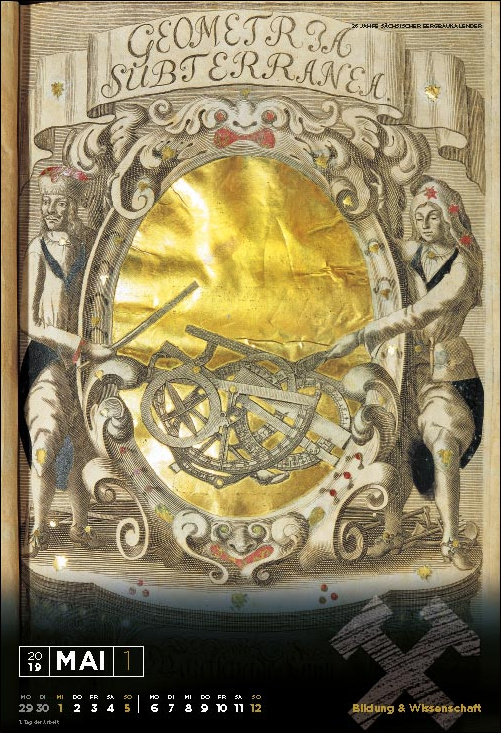
MAY 1 · 2019
Geometria subterranea – education and science
Geometria subterranea oder Markscheide-Kunst, a work on mine surveying. Credit: University Library of TU Bergakademie Freiberg, historical collections.

MAY 2 · 2019
Zug near Freiberg – shaft
Herzog Friedrich August Fundgrube, Drei Brüder Schacht: mine workings at the level of Rothschönberger Stolln. Photograph: Jens Kugler.
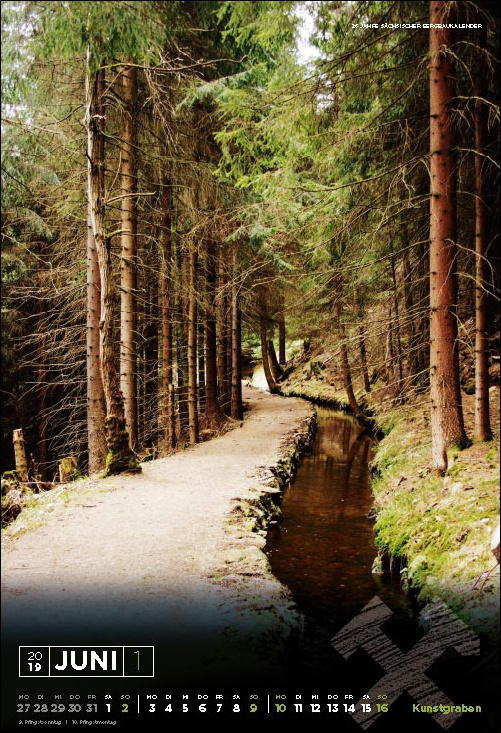
JUNE 1 · 2019
Freiberg mining-water system – water channel
A water channel of Freiberg’s mining-water management system. Photograph: Jens Kugler.
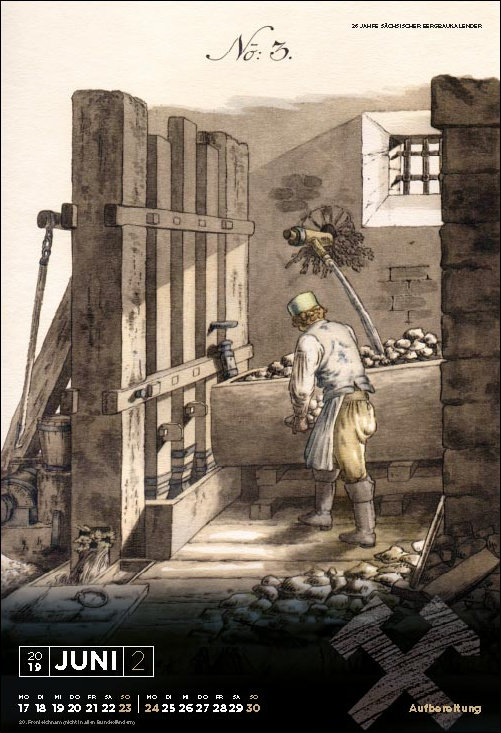
JUNE 2 · 2019
Zschopenthal – ore processing
A wet stamping mill at the Zschopenthal blue-pigment works. Historical drawing; credit: University Library of TU Bergakademie Freiberg.
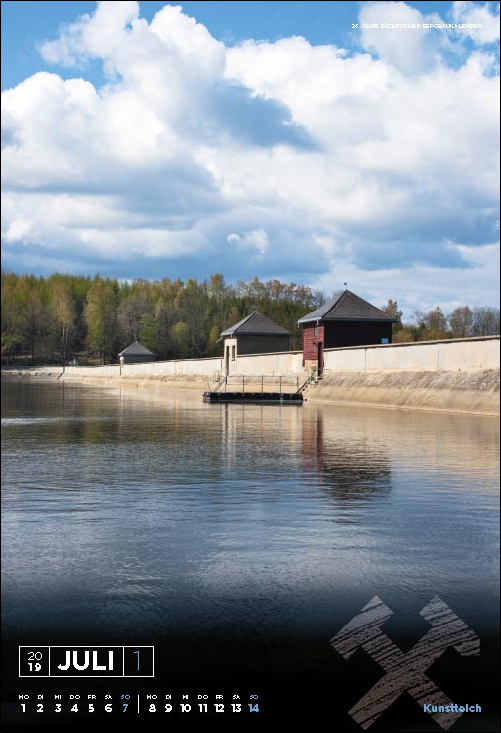
JULY 1 · 2019
Dörnthal – mining reservoir
Dörnthal reservoir, part of Freiberg’s mining-water management system. Photograph: Jens Kugler.
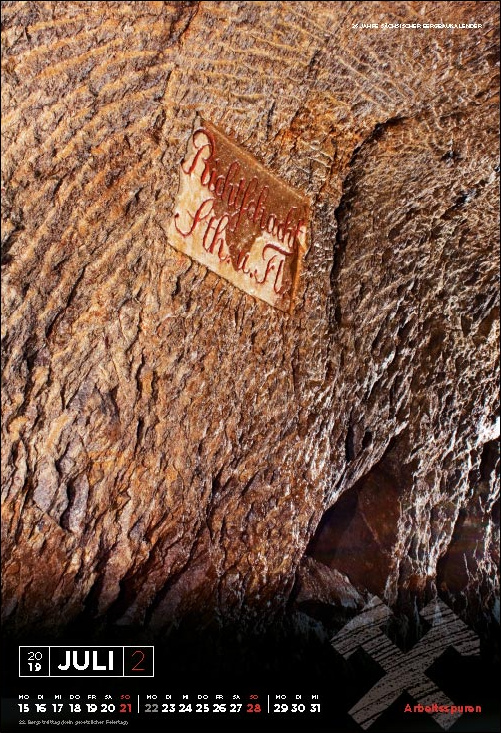
JULY 2 · 2019
Hammer and chisel – working traces
Traces of hammer-and-chisel working in an adit. Photograph: Jens Kugler.
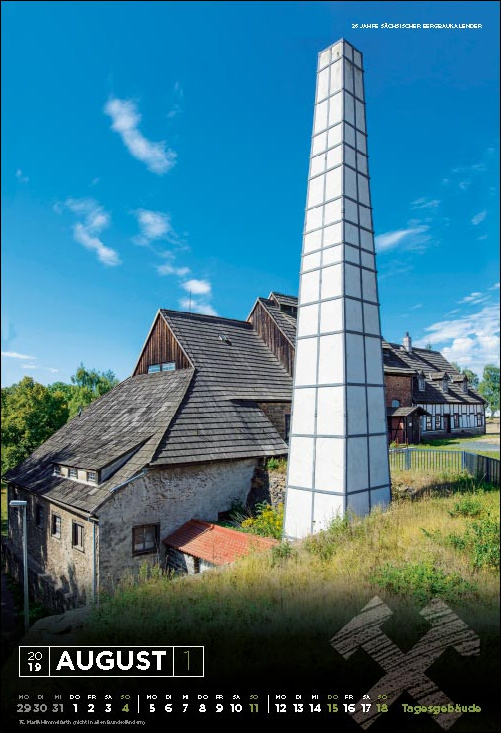
AUGUST 1 · 2019
Freiberg – surface buildings
Himmelfahrt Fundgrube, Alte Elisabeth shaft: surface installations. Photograph: Jens Kugler.
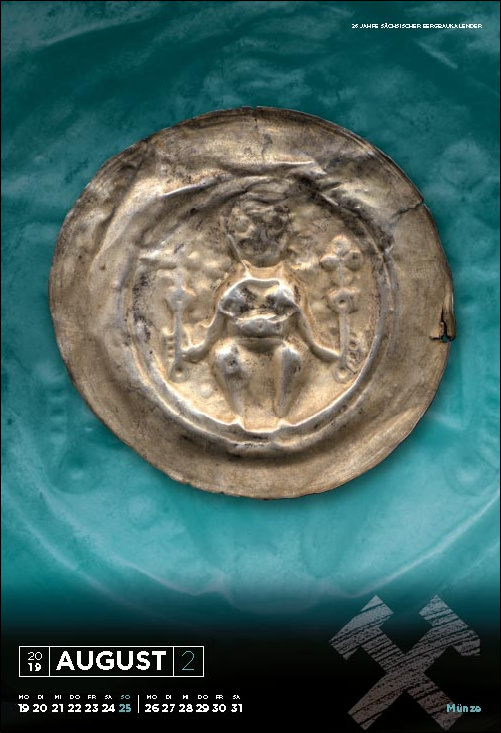
AUGUST 2 · 2019
Freiberg – coinage
A Saxon bracteate dating from around 1200, bearing a ruler’s portrait. Collection and photograph: Jens Kugler.
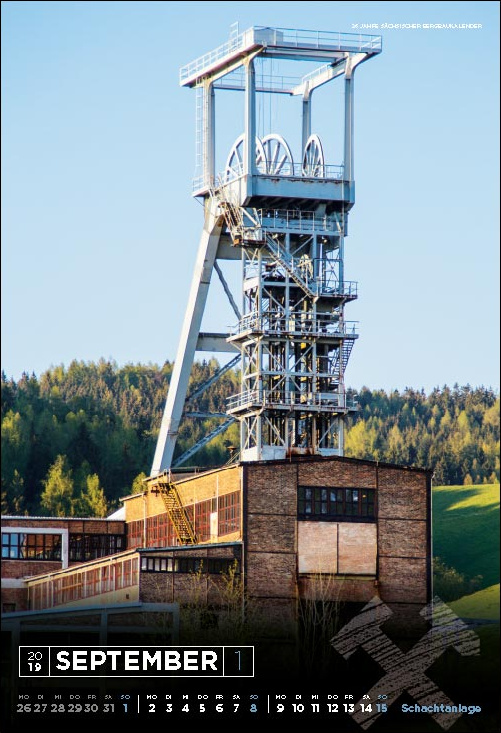
SEPTEMBER 1 · 2019
Hartenstein – shaft installation
SDAG Wismut, Object 09: headframe of shaft installation 371. Photograph: Jens Kugler.

SEPTEMBER 2 · 2019
Neustädtel – adit portal
Adolph Stolln at the Filzteich: adit portal. Photograph: Jens Kugler.
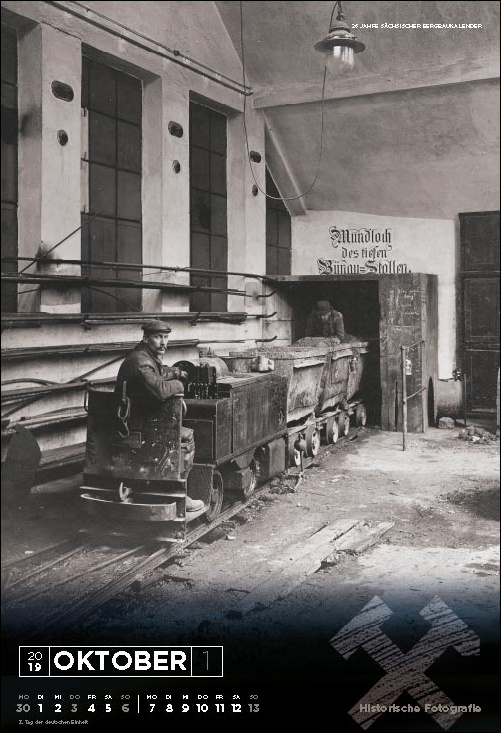
OCTOBER 1 · 2019
Historical photograph – mineral collection
A historical interior photograph of a mineral collection. Historical photograph; credit: Saxon State and University Library Dresden.
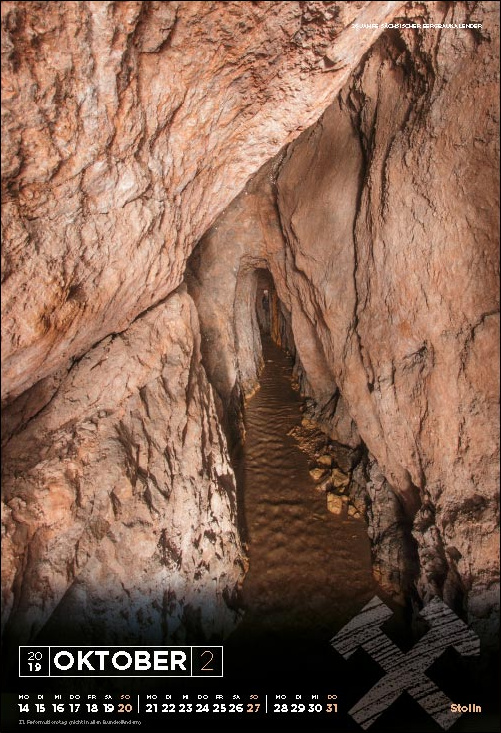
OCTOBER 2 · 2019
Schlettau – adit
Johannes Stolln: an adit cross-section. Photograph: Jens Kugler.
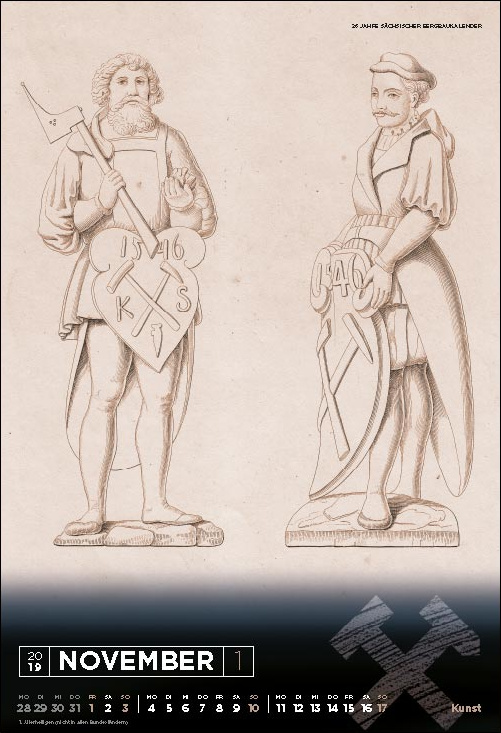
NOVEMBER 1 · 2019
Freiberg – art
Freiberg Cathedral: sixteenth-century miners from the miners’ seating. Historical drawing; collection: Jens Kugler.

NOVEMBER 2 · 2019
Freiberg – mineralogy
Himmelfahrt Fundgrube, Alte Elisabeth: mineral deposits precipitated from mine water. Photograph: Jens Kugler.
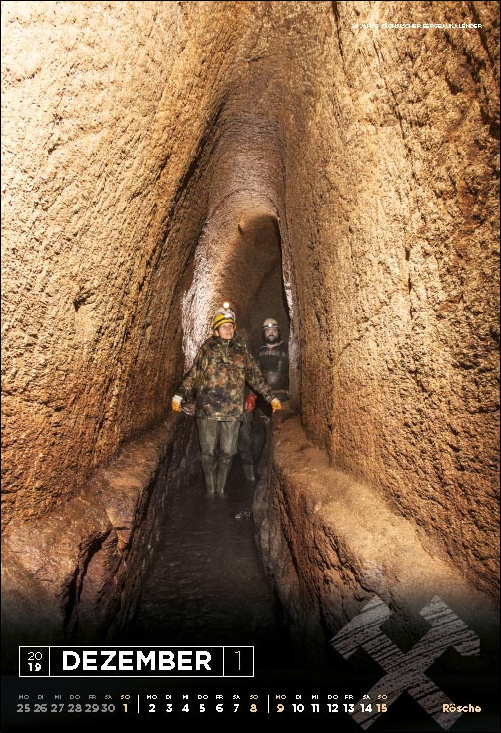
DECEMBER 1 · 2019
Muldenhütten – water tunnel
Muldenhüttener Rösche: a former tailrace dating from the end of the sixteenth century. Photograph: Jens Kugler.

DECEMBER 2 · 2019
Marienberg – mining traditions
A miner from the Marienberg mining brotherhood at a ceremonial miners’ tattoo. Photograph: Jens Kugler.
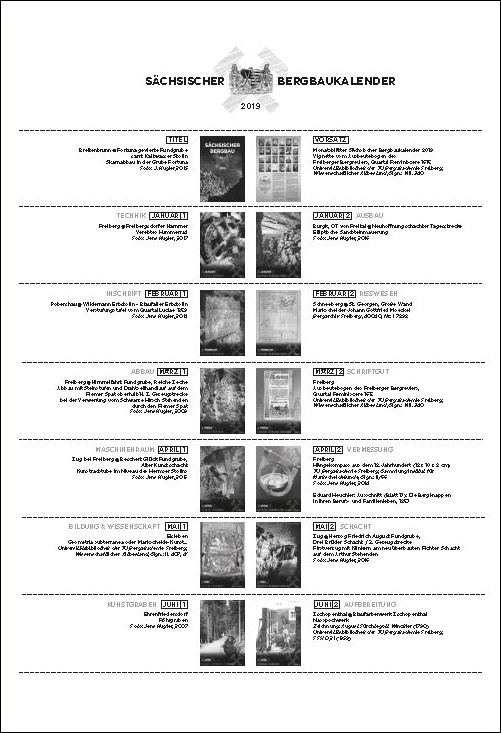
NOTES 1 · 2019
Cover to June – image credits
The original page contains locations, descriptions and source credits for the cover, foreword and January to June.
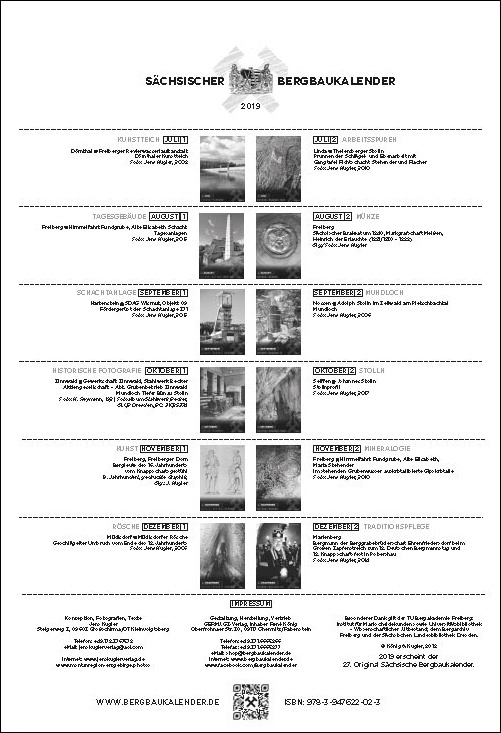
NOTES 2 · 2019
July to December – image credits and imprint
The original page contains descriptions and image credits for July to December, followed by the imprint and acknowledgements.


